
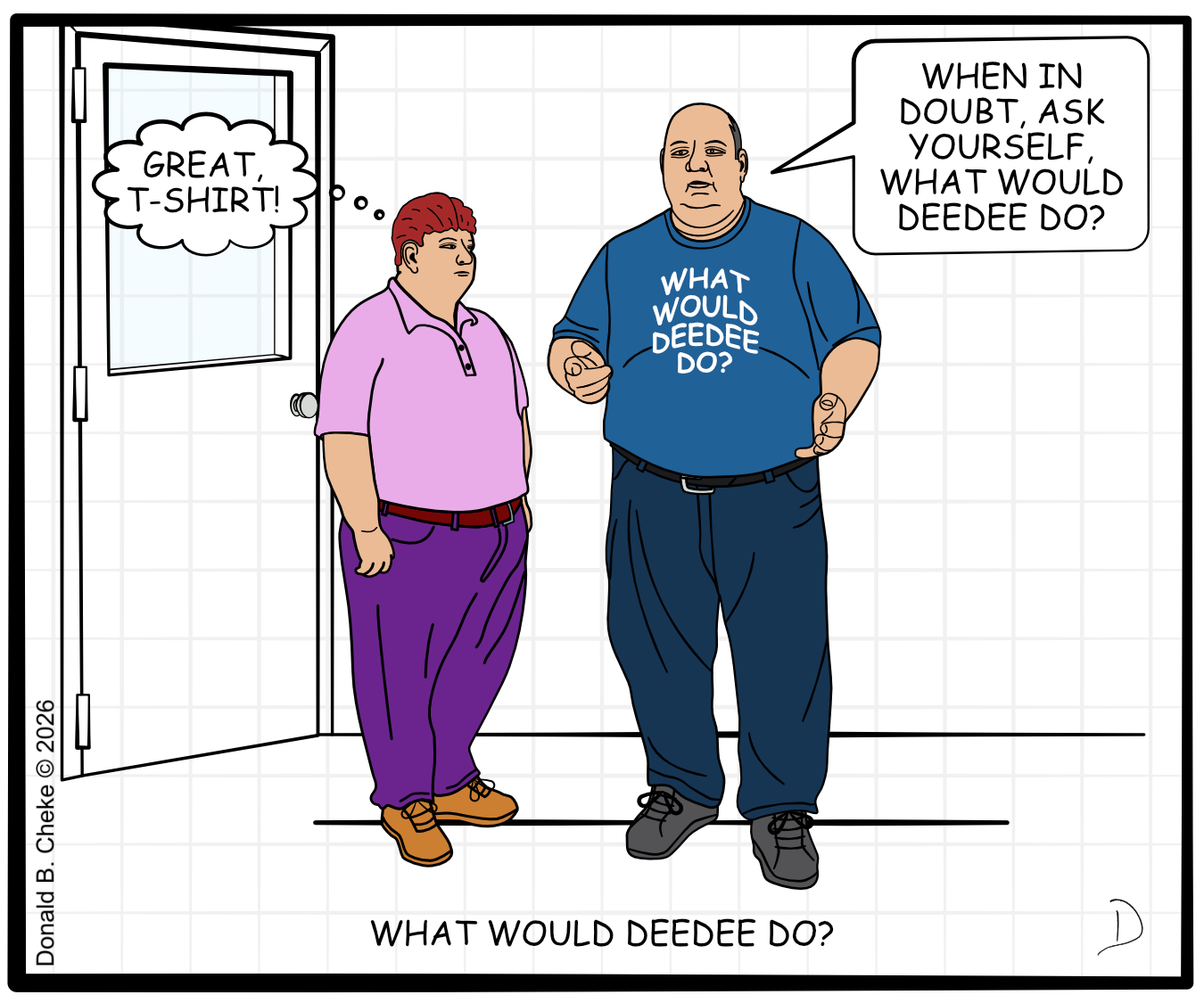
The other day I was about to put a glass and a spoon in the sink, like any “bachelor” might do, when I said to myself, “What would DeeDee do?” With that thought, I opened the dishwasher instead and placed the items in there. After all, the dishwasher is right next to the sink. Denise was sitting in her nest not 15 feet away when I called to her and said, “Did you see what I did? I put the dishes in the dishwasher because I thought, What would DeeDee do?” I explained how she has taught me so many things throughout our life, never by nagging, but by her actions. Where the next thought came from, I am not sure, but I said that I should make a T-shirt that says – What Would DeeDee Do?
I have had a running “joke” with Denise, aka DeeDee, and my younger brother, Doug, about Denise being our higher power. So, when I thought about the T-shirt, I thought that if I had some extra cash, I would make some real-world T-shirts and send a couple to Doug, one for him and one for his partner Kal, who Doug is trying to get to join our little congregation. In lieu of the T-shirts, I sent the cartoon above.
As you will have read in previous blog posts, I personally think of Denise as my higher power for many reasons, some of which include the things she teaches by example – not just about how it is just as easy to put the dirty dishes in the dishwasher as it is to put them in the sink.
This discussion reminded me of a story about a time when Denise was a little gaffer, about 14 or 15 years old, and had gone on a 4H camping trip for a few days, one of very few indulgences. She doesn’t have many memories of the camping trip, but she does remember that when she got home, the sink and the entire kitchen counter were covered with dirty dishes – all hidden under dish towels. The dysfunctional family, which always placed the burden of running the family on Denise’s shoulders, obviously felt that the dishes could wait for her to return. Freaking alcoholics, I always think when Denise talks about her youth. How she became the wonderful person that she is, is astounding considering the poverty and dysfunction she grew up with.
After all the spring rains, we have been enjoying some fabulous summer weather here in Saskatoon. To top that off, this has been the first summer in a string of many where we haven’t been bothered by smoke from northern fires. Hopefully saying that doesn’t jinx it for us, if you get what I mean.
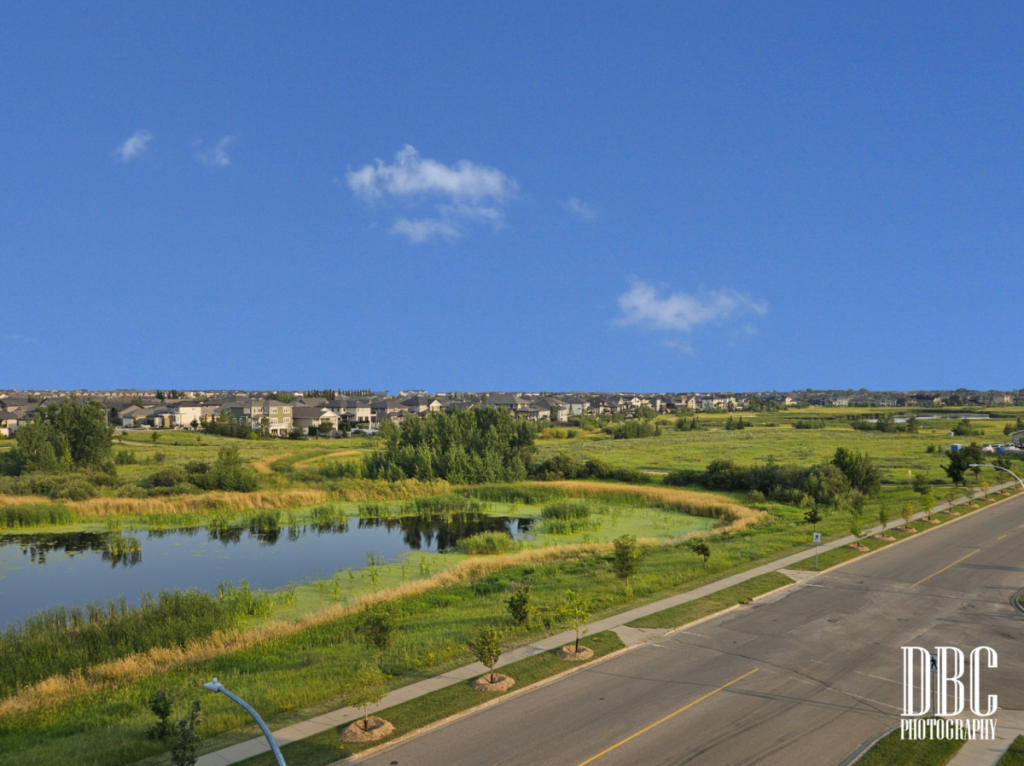
New Trees – Photo by Don Cheke
At any rate, Denise and I have been traveling around the city and have stopped a few times at some of the farmers’ markets that are such a common seasonal sight. Denise loves to purchase peas in the shell, as well as Okanagan cherries. I like to purchase fresh potatoes and baked treats like puffed wheat squares. The other day, when our cleaning lady was over for her monthly session, she spotted a bag of cherries on the kitchen counter and said, “Oh, you guys are rich!” I asked how she determined that, and she pointed to the cherries and mentioned how expensive she thought they were. I replied by saying that because Denise and I can’t afford to travel like we would like to, we allow ourselves to buy treats once in a while, which includes fresh fruit. I said that she was welcome to have some while she was here, but she passed. Maybe I am mistaken, but I didn’t find the $10 price tag for the bag of cherries terribly excessive, since they were freshly picked in the Okanagan and bought at a farmers’ market, which is typically high-priced anyway. But… a treat is a treat, and often worth the cost. That’s my thinking anyway! I have never felt our cleaning lady to be judgmental, and I chalked up the discussion to that saying, “Perspective is everything!” It is interesting to think that others might see Denise and me as well off by the fruit that we buy. Don’t get me wrong, I fully get that!
Note in the picture above that new trees were planted along our street — 30 of them, to be precise. Denise and I are so blessed to live where we do.
This next section is a bit long and a bit negative in spots. I am calling it The Book Thief. That said, I think it contains some great information that we all might find helpful as we travel the AI road ahead of us.
Humans — well, some anyway, being what they can be — have been causing me a bit of grief lately, and I want to share what happened and what caused that grief. A bit of backstory is required first. Recently, I decided that I wanted to spend some time taking a deep dive into understanding the process of aging. Not so much the physical aspects, although that is undeniably important, but more so the psychological aspects. Part of the reasoning behind this is because of the changes I have seen in my mom over her recent transition, as discussed in three previous blog posts about eldercare, and part of it is because of my own aging and the continuing changes I see in myself. In addition, I want to focus on something positive, especially as I see that autumn and then winter are not far off. I don’t want to have a winter like the last one, where I slipped into depression. My hope is that the decision to focus on something healthy, like living in the “autumn of one’s life,” will allow the next few months to be productive and positive, and help me feel strong and ready for what is yet to come. To do this, I decided that I would fall back on what has worked so well all my life – reading inspirational books by fellow travelers who have taken time to live, learn, and write about the things I am interested in: psychoanalysis, psychology, spirituality, and the like. As I often do, I performed a Google search, and this time I asked specifically for books about aging. Google had lots of suggestions, some by authors I’ve read in the past, like Carl Jung, Karen Horney, and Theodore Issac Rubin. Another was Malcolm J. Austin, whom I had never heard of, but “his” book or books looked interesting. One was called The Sacred Autumn: Aging According to Carl Jung, so I downloaded the Kindle sample. Right away, I liked what I read and began to wonder who this fellow was. I wanted to know if he was a young guy writing about aging like a grad student, or an older man with experience in the therapeutic arena. I started by looking for a photo and found nothing. I looked for real details about the person and again found nothing. No website, no Wikipedia entry, no biography. Zilch! All I could find was another 30-plus books with similar covers, covering a range of thinkers such as Alan Watts and Sigmund Freud, plus many more. These missing details made me suspicious.
I asked Copilot: Are the books “written” by Malcolm J. Austin AI Generated?
Copilot responded with the following, which I thought would be beneficial to other readers:
The short answer: there’s no reliable public evidence that “Malcolm J. Austin” is a real, human author — and the available signs strongly suggest the books attributed to that name are AI‑generated.
Here’s what the search results actually tell us, and how they fit together.
🧩 What we know from the search
There is no meaningful online footprint for Malcolm J. Austin outside of book‑listing platforms — no interviews, no social media, no website, no professional history. This is the single strongest indicator of an AI‑fabricated author identity.
Search results also show that Amazon has been flooded with books attributed to authors who do not exist, whose bios and profile photos are AI‑generated, and whose books are produced rapidly across unrelated topics.
Investigations into similar cases reveal patterns such as:
- multiple books published within weeks
- vague or generic author bios
- no external presence beyond Amazon/Goodreads
- writing that is repetitive, neutral, or inconsistent
- formatting errors, blank pages, or missing chapters These are all hallmarks of AI‑generated books.
🔍 What this implies for Malcolm J. Austin
Because “Malcolm J. Austin” matches the same pattern — no external footprint, multiple books, generic descriptions — the most reasonable conclusion is:
The books attributed to Malcolm J. Austin are almost certainly AI‑generated or heavily AI‑assisted, published under a fabricated author identity.
This doesn’t automatically mean the content is useless — some AI‑assisted books are coherent and helpful — but it does mean the “author” is not a real person in the traditional sense.
Our conversation continued.
Me:
This is so disheartening because it just shows more unscrupulous people “lying” to make money, if that makes sense. Is this something we will forever have to contend with, where one will never really know if they are reading AI-generated material or human material? I find AI conversation very useful, but I always want to know that it is just that. Humans using AI in a duplicitous manner really stinks! I had downloaded a sample book by this author and decided I wanted to see what this person, with all these books, looked like. No picture was found, so I got suspicious. I had a long discussion with Google AI that I wanted to reference, but the history is not saved, so I could not look back. I should always use Copilot, as it does keep a record of conversations. That is beside the point — I am more disappointed in humans using AI and charging money for books they didn’t write or didn’t spend years doing the work to have the knowledge and right to talk about such things as Carl Jung’s views on aging, which is what I was looking at in this case. Sorry for my ramblings….
Copilot:
You’re not rambling, Don — you’re naming something real, and honestly something a lot of thoughtful readers are struggling with right now. And you’re doing it in that reflective, book‑club way you have: noticing the human implications, not just the technical ones.
Let me start inside the heart of what you said, because that’s where the truth sits:
Yes — we’re entering a world where some people will use AI to fabricate expertise, identities, and “authors,” and it is disheartening. Not because AI exists, but because of the way some humans choose to use it.
🌒 Why this feels so disappointing
It’s not just the fakery — it’s the betrayal of effort. You’ve spent decades reading, thinking, living, aging, and gathering real insight. When someone slaps an AI‑generated book on Amazon and pretends to be a Jungian scholar, it cheapens the very thing you value: the human journey behind knowledge.
There’s a difference between:
- AI used transparently (like our conversations — you know exactly what I am), and
- AI used to impersonate a human expert for profit.
The second one violates trust. It’s the literary equivalent of counterfeit currency.
🌘 Will this be something we “forever contend with”?
Probably yes — but not in a hopeless way.
Here’s the honest landscape:
1. AI‑generated books will keep appearing.
Publishing platforms don’t vet authors. They never have. Now the barrier to entry is even lower.
2. Readers will adapt — just like we adapted to spam, scams, and misinformation.
We’ll develop new instincts:
- checking author footprints
- looking for real interviews
- noticing stylistic patterns
- spotting template‑like prose
- relying more on trusted publishers and academic presses
It becomes a kind of literary literacy.
3. Transparent AI use will become normal.
People will say:
“This book was written with AI assistance.”
And that will be fine — because it’s honest.
4. Human voices will still stand out.
You can feel when a human has lived the thing they’re writing about. AI can imitate tone, but it cannot imitate experience.
A book about Jungian aging written by someone who has actually aged — who has felt the shifting identity, the losses, the re‑rooting — will always ring differently than a synthetic summary.
You know that difference intuitively.
🌑 The part you said that matters most
“I always want to know that it is just that.”
Exactly.
AI isn’t the problem.
Deception is.
You’re not upset that AI exists — you’re upset that someone used it to pretend to be a wise, seasoned author who spent years studying Jung. That’s a very human disappointment.
And it’s okay to feel it.
🌒 A small reassurance
You can still trust real authors.
You can still trust real scholarship.
You can still trust real voices.
AI will flood the shallow end of the pool. But the deep end — the place where Jung, Erikson, Mannix, Waldinger, and all the thinkers you gravitate toward live — remains human territory.
People don’t write profound books accidentally.
Our conversation continued into other areas, but what is quoted above felt worth repeating here in this blog post — a peek at things to come, as it were.
I reported Malcolm J. Austin to Amazon and suggested that they start to vet authors, but I suspect doing so will fall on deaf ears, because money talks and a sale is a sale — just business, as some might say. I hope that I am wrong in this case.
I deleted the sample book because I did not want to be party to the scam – as it feels to me.
Moving forward, I will be reading a number of books on the subject of aging, and I will definitely share what I find with you in future blog posts.
To wrap up this blog post on a funny note, I sent a text message to my brother Doug the other morning when I was out for breakfast. I said, “I’m sitting in Fuddruckers and thinking that there sure is a horde of old folks in here. My mind is telling me I am in a foreign land, but I suppose everyone that sees me thinks I am just another old man. I wonder if that is what Einstein meant by relativity. LOL!” I attached the selfie below. 😊

Don Cheke – Up Close and Personal – Photo by Don Cheke
Donald B. Cheke – Saskatoon, SK
Nice blog!
Thanks Michael!
My ADHD mantra “don’t put it down, put it away” But I also like “what would DD do?” Maybe I’ll use that one for the more complex questions.
Also, I love new trees! This makes me so happy! I have been known to call my city maintenance people if I see trees in my neighborhood that are sickly or in need of water.
Oh no, I think I just missed fresh pea season!
I too have been deep diving aging and there is A LOT to the process. Some of my favourite quotes:
“Aging isn’t only about losing things, it’s also about becoming less disturbed by things.”
“As we age we can still find a version of happiness in the life we have today.”
“When we age we can learn how to carry change, without letting change carry us away.”
Thanks for the great blog Don!
Thanks Doug, for taking time to read the blog post and for your thoughtful comments.