
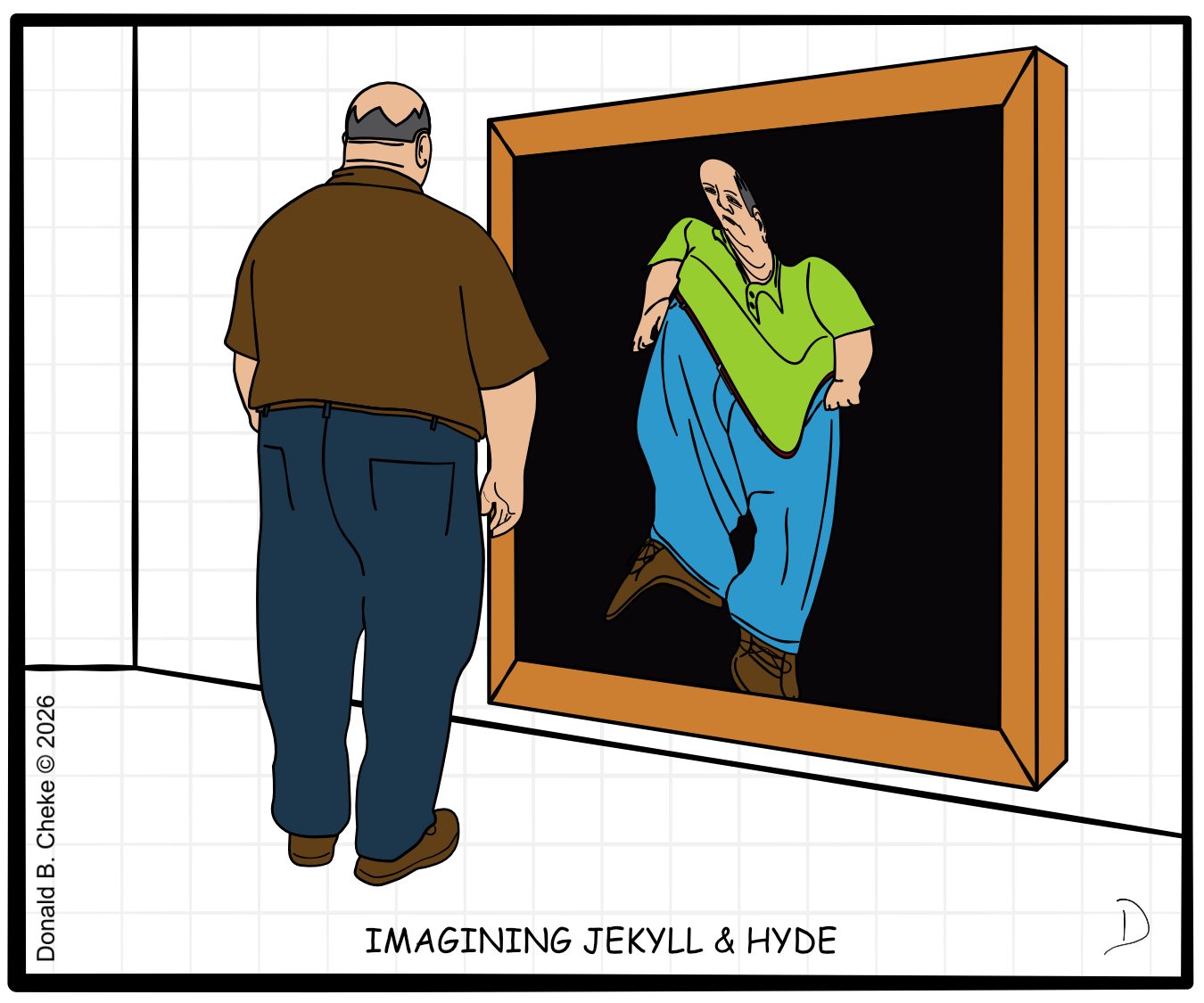
Today, we will spend time reflecting on Robert Louis Stevenson’s 1886 book “The Strange Case of Doctor Jekyll and Mr. Hyde” (Library Edition). I read the Kindle edition published by Grapevine on December 17, 2024. The print length is listed as 86 pages, so it is a novella rather than a full-length book.
I am sure most people have heard of Dr. Jekyll and Mr. Hyde, but I wonder how many have actually read the book. I was one of those people who had heard of it but hadn’t read it until recently. I did so because I wanted to see what the author was getting at when he penned the piece. Previously, I had other interpretations in mind when I thought about these characters. Perhaps you remember me mentioning them in previous blog posts, where I related them to the change one might see in alcoholics when drinking — that shift from civilized person to raging lunatic, or some such thing.
To set the stage further, and to give those unfamiliar with the book a heads-up, here is the Amazon.ca book synopsis:
The Strange Case of Doctor Jekyll and Mr. Hyde (Library Edition) is Robert Louis Stevenson’s iconic novella exploring the duality of human nature. In this classic tale, Dr. Henry Jekyll, a well-respected doctor, creates a potion that transforms him into the evil and immoral Mr. Hyde, allowing him to indulge his darkest desires without facing the consequences. Through vivid descriptions and psychological depth, Stevenson delves into the conflict between good and evil within the human soul. This edition offers a timeless exploration of identity, morality, and the complexity of human nature, making it a must-read for fans of gothic fiction and classic literature.
After reading this intro, I hesitated because I thought “gothic” might mean “horror,” a genre I typically don’t enjoy. Still, my desire to see what the book had to offer won out.
By about chapter 4, I found that the writing was excessively wordy and that I might miss the actual details of the plot because of it. At this point, I had a discussion with Copilot, and it mentioned two things that made sense. The first was the fact that authors of the Victorian era prized regulated, formalized speech as a marker of refinement and self-control. It also mentioned that characters like Utterson, Jekyll, and their peers belong to a professional class that “subscribe to austere rules of conduct,” and that this austerity shows up in “formalized, imitative manners of speech” meant to signal restraint rather than originality. I argued that I had read other authors of the era who didn’t seem to be trying to show how smart they were by talking over the heads of their readers. I mentioned H.G. Wells as an example, and Copilot further explained the differences in tone — professional in Dr. Jekyll & Mr. Hyde, and more journalistic and action-driven in many of the H.G. Wells stories. That made sense to me, so I continued reading while paying close attention to the subtle, hidden details.
By the end of the book, I did find it worth the time it took to read, but I also found that I could have simply read the last part to get the full picture, without all the preliminary material that built the story to its crescendo and resolution. The last part of the book, Henry Jekyll’s Full Statement of the Case, is where Jekyll himself explains everything in detail within letters to two friends.
So, let’s look now at the essence of the book – what the author was trying to show us and have us think about.
Based on what I read, and what scholars have said, the book is about the dual nature of human beings: the tension between our socially respectable selves and the impulses we hide. Several late-Victorian anxieties shaped that theme, including evolution, degeneration, criminal psychology, and moral respectability. In that view, Stevenson’s central message is that every person contains opposing forces — good and evil — locked in perpetual conflict. His twist is that evil does not merely coexist with good; when indulged, it can grow stronger until it overwhelms the good. So, the book isn’t moralistic in the sense of “good triumphs.” It’s more tragic: once you open the door to your darker impulses, they may take over.
To try to understand what the roots of the book were, I asked Copilot to elaborate.
Me:
What would you say was at the root of what Stevenson was trying to convey? Was it about drugs or alcohol, where the user’s personality changes? Was it about mental illness? Or was it just a basic look at the dual nature of man? Is there something in Stevenson’s life history that would have made him ponder this duality?
Copilot replied with the following breakdown, which I thought answered my various questions quite well:
🎭 The root idea: the dual nature of man
Stevenson’s central message is that every person contains opposing forces — good and evil — locked in perpetual conflict. Dr. Jekyll himself describes these as “polar twins… continuously struggling.”
This isn’t just a metaphor — it’s the entire architecture of the story. Hyde isn’t a separate creature; he’s the part of Jekyll that Victorian society forced him to repress.
Stevenson’s twist is that evil doesn’t just coexist with good — it can grow stronger when indulged, eventually overwhelming the good. Scholars note that the novel warns of “the strength and ultimate triumph of evil over good once sin is suffered to enter human habitation.”
So, the book isn’t moralistic in the sense of “good triumphs.” It’s more tragic: once you open the door to your darker impulses, they may take over.
🧪 Was it about drugs or alcohol?
There’s no direct evidence that Stevenson intended the potion as a metaphor for substance abuse. But the effect of the potion — disinhibition, personality change, loss of control — certainly resembles what we’d now associate with addiction.
Still, the sources emphasize that the potion is primarily a symbolic device: a way to dramatize the split between Jekyll’s public respectability and private desires. It’s not meant to map neatly onto any specific substance.
🧠 Was it about mental illness?
Not in the modern clinical sense. Victorian psychology didn’t have today’s vocabulary, but the idea of a “double self” or “split personality” was already circulating. Later psychologists (Freud, Jung, Horney, Jones) retroactively connected the novel to dissociation and the unconscious.
Stevenson wasn’t diagnosing Jekyll — he was dramatizing the idea that a person can contain contradictory selves that cannot coexist peacefully.
🧬 Was it about evolution and degeneration?
This was a major Victorian concern, and Stevenson absolutely tapped into it.
Hyde is repeatedly described as “ape-like,” “troglodytic,” and “hardly human.” These descriptions echo Darwin’s Descent of Man (1871), which unsettled Victorian readers by suggesting that humans descended from primitive creatures. Hyde embodies the fear that beneath the polished Victorian gentleman lurks something more primitive — a regression rather than a transformation.
So yes: the novel is partly about degeneration, a fear that civilization is a thin veneer over something animalistic.
🏛️ Was it about Victorian society itself?
Absolutely. One of the most important scholarly points is that Stevenson wasn’t just showing the dual nature of one man — he was showing the dual nature of society.
London itself is portrayed as respectable streets beside squalid, violent ones. Respectability and degradation coexist everywhere. Jekyll is simply the most extreme example.
👤 Did Stevenson’s life inspire this?
Sources don’t point to a single biographical trigger, but they do show that Stevenson was deeply interested in:
- moral hypocrisy
- the masks people wear
- the conflict between public virtue and private vice
He grew up in a strict Calvinist household and later rebelled against its moral rigidity. That tension — between outward propriety and inward desire — is exactly what Jekyll embodies.
Stevenson also suffered from chronic illness and lived a life full of physical constraint, which may have sharpened his interest in the idea of hidden selves and suppressed impulses. (This is an inference based on his biography, not a direct claim from the sources.)
🧩 So what was he really trying to convey?
Putting the sourced pieces together:
- Human nature is inherently dual — good and evil coexist.
- Indulging the darker self strengthens it until it dominates.
- Victorian respectability hides primitive impulses; it does not erase them.
- Society itself is split between polished surfaces and hidden corruption.
- The double self is psychologically real, even if dramatized.
If you boil it down: Stevenson was exploring the terrifying possibility that the self we present to the world is not our whole self — and that the part we hide may be stronger.
(Copilot cited BritishLibrary.cn and eNotes.com as sources for this summary; I have not independently verified those sources here.)
So where does this leave us? What do you believe about the dual nature of humans, as presented by Stevenson, and what can you surmise from the material above?
Having looked at Stevenson’s idea from several angles — the book itself, the historical context, and Copilot’s summary of the scholarly view — I want to turn now to my own reaction. Below are my thoughts as I considered these questions.
To be honest, I don’t believe that “every person contains opposing forces — good and evil — locked in perpetual conflict.” To me, that statement feels simplistic and naïve, almost as if we are driven by some poorly named force. My point of view is that we are complex beings with the ability to do good or to do bad, just as we are capable of restraining ourselves from doing things we know are bad and, on the other hand, choosing to do good — actually taking positive steps to do just that. Even then, there is not much that is all bad or all good, since most things exist in shades of gray.
I do believe that we have an inner and outer persona that can indeed look like a Jekyll and Hyde type of thing, but it is my belief that any human who is on a journey to recovery, or looking to travel on a healthy spiritual path, spends their life trying to make the inner and outer self reflect the same face. I understand that people can struggle to make good choices, but that doesn’t mean there is some evil proponent trying to make that happen. While writing this, I am reminded of free will — again, the ability to choose, something that all conscious beings have been given. Some may argue that there are mentally ill people who have lost the ability to choose good or evil, and that may be so, but I suspect that is far outside the norm and not really relevant to this discussion.
All that said, I believe The Strange Case of Dr. Jekyll and Mr. Hyde offers readers a chance to examine how honest we are about ourselves and what we are willing to show the world. I know from personal experience that when I was younger and unsure of myself, I went to great lengths to hide my true self. I wore the uniform of the day — jeans and a jean jacket — so I would not stand out. If I was singing in my car and someone pulled up beside me at a stoplight, I would stop. I kept my opinions to myself and often felt that if people really knew me, they would judge me harshly. As a side note, it is mind-boggling to me how many people today seem far more willing to draw attention to themselves through tattoos, unusual haircuts and colors, or outlandish clothes.
As I continued in recovery and learned to accept, and even love myself, my inner life began to look more like the person I showed to the world. My exterior changed too, because I became more confident in who I was and what I believed. I still can’t sing in the car with any kind of audience, and I still dress very low key, but I genuinely reflect the calm I feel within — as humanly as possible. As for the voice within, I absolutely hear it, but it is not an evil force trying to sway me toward dark impulses. It is my baggage trying to make me doubt my growth and avoid using the tools I have for living well. Perhaps, too, it provides an opportunity to sharpen those tools.
To further the topic, I decided to ask my wife, Denise, about her thoughts on the duality of human nature as presented in the book. She replied with:
One of the first things I thought about was an indigenous story where an elder tells his grandson about how there are two wolves within us. Good and bad or good and evil, or whatever you want to call it. The young Indigenous grandson asks, “how do you know which one will win?” The grandpa replies with, “whichever one you feed, so if you feed the good one, that’s the one that will triumph. If you feed the evil one, that one will prevail.” But that’s a very simplistic explanation of the dual nature of good versus evil. I’ve been giving it some thought since you asked me this morning to do so, and like I said, initially, I would have been inclined to agree with a simplistic answer like that. Going deeper, I just don’t believe that. I think we’re born as good, with that good nature and through the course of our lives we each have the potential to do “evil” things, you know, to do bad things, but I don’t think that makes us a bad person. Really, it’s just the circumstances of our lives, and the messages and the baggage that we carry, that maybe entices us to make bad choices and do evil things. I’m not using that as an excuse, but even if you look at somebody like Hitler and you say, well, he was just pure evil, I suspect that he was not pure evil, that he acted the way he did through choice, because of his brand of baggage, his upbringing, his mental health issues, whatever he based his choices on, which looked very evil to most of us.
No matter what we do, I think each of us is redeemable, even at the very end, or maybe not until the very end. I don’t think we are born with an evil twin inside us fighting to take over. If I were of a certain religious persuasion, I might say that we are tempted to do bad, or that the devil, or whatever else one might call it, is choosing for us. But I don’t believe that. I think, as you said, we are given free will, so we choose. In summary, I don’t think that kind of duality exists.
Wise words from DeeDee, to be sure!
At this point I don’t really have anything further to say on the subject so I will wrap up by recommending the book to those interested in delving deeper into the possible dual nature of humankind.
Donald B. Cheke – Saskatoon, SK