
In today’s short blog post, I will share a couple of recent medication changes I have made related to my mental and physical health. For fun, I created editorial cartoons to go along with the stories.
If you have been following my blog posts, you will already know that I was diagnosed with Type 2 diabetes a couple of years ago. For quite a while, I tried to manage it with exercise and “healthy” eating. Not surprisingly, I was never consistent and succumbed to old patterns in short order. A few months ago, my doctor suggested we try Metformin to lower my blood sugar levels. This was a complete failure, as I suffered a terrible reaction to it. I thought that if this was the cure, I’d rather die of sugar-clogged arteries. Rather than letting things run rampant, my doctor suggested we try something else; after all, she said, there is more than one option available. We settled on giving Gliclazide a try, starting with a smaller dose. After three months with no visible change, my doctor doubled the dose to its allowable maximum. It was at this time that we also discussed the “miracle” drug called Ozempic. Studies showed remarkable success both in lowering sugar levels and in weight loss. At the time, my doctor said it cost two or three hundred dollars a month, but a generic brand was coming out in the near future, which would lower the cost.
Roughly three months later, after another blood test to see where my blood sugar level was at, we noted that the Gliclazide was not working well either. My doctor said that since we had now tried two diabetes medicines that were not proving effective, and with the generic brand of Ozempic now available, some drug plans were covering the new product for special-needs patients such as me.
A prescription was sent to my pharmacy, and to my surprise, when I picked it up, it was the original Ozempic brand and the patient share was $0.00, saving me a bundle. According to the pharmacy printout, the original price is $279.58, and the patient share is listed at $159.36. My special status seems to have brought this down to zero for me and for other patients who meet the criteria.
Ozempic comes in a pen-shaped device to which the patient attaches a small needle. The dose is one shot per week, injected subcutaneously into the stomach area, the thighs, or the upper arms. Very simple.
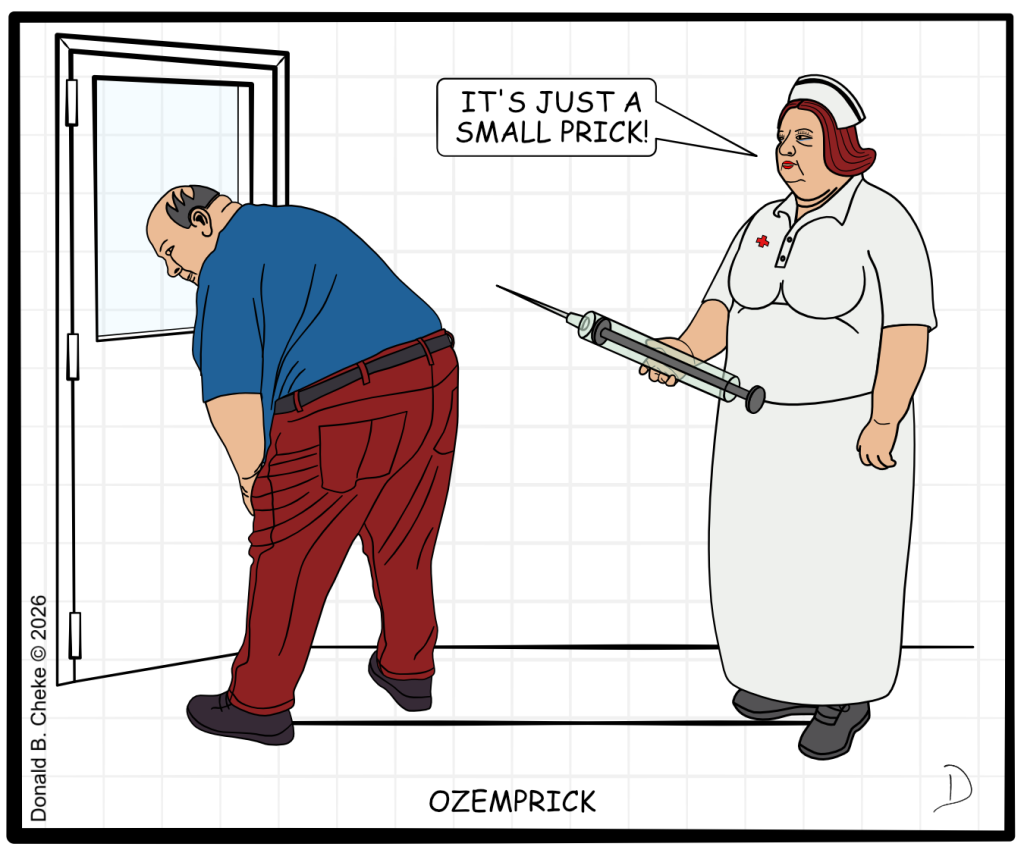
Ozemprick – Created by Don Cheke
Some hours later that same day, I was already feeling different, so I asked Google AI about the processes this medicine initiates and whether it was possible for it to be working already. I want to share some of that discussion and how I felt during it. I think it makes an interesting point that explained so much about my case. My thoughts, in blue, were added as I wrote this blog post.
Me:
Is it possible to start feeling positive results from the first shot of Ozempic?
Google AI:
Yes, it is entirely possible to start feeling positive results from your very first shot of Ozempic. While the medication begins working at a cellular level within hours and peaks in your bloodstream within 1 to 3 days, individual experiences vary significantly. [1, 2, 3, 4]
For many people, the earliest positive signs are behavioral and perceptive rather than a sudden change on the scale. You might notice these immediate shifts during the first week: [5]
- A quieted mind (“Food Noise” reduction): Many individuals report a sudden, dramatic drop in constant thoughts about food, cravings, or the urge to snack within 24 to 48 hours of their first injection. [6, 7]
- Rapid fullness (Satiety): Because Ozempic immediately begins slowing down how quickly your stomach empties, you may notice you feel full much faster during meals and stay satisfied for longer periods. [3, 6]
- Stabilized blood sugar: If you are monitoring your glucose for Type 2 diabetes, you may see your daily fasting or post-meal numbers begin to smooth out or drop within the first few days. [8, 9]
Why the overall timeline requires patience
It is important to keep in mind that the standard starting dose (0.25 mg) is primarily designed as a transitional dose to help your body safely adjust to the medicine, rather than a therapeutic dose for maximum weight loss or long-term A1C control. It takes 4 to 5 weeks of consistent weekly dosing for Ozempic to build up to a steady, continuous level in your system. Significant health changes—such as a noticeable reduction in your 3-month A1C test or substantial weight loss—typically manifest over 8 to 12 weeks as your dosage is safely increased by your doctor. [2, 3, 4, 10, 11, 12]
Because everyone’s metabolic rate and baseline insulin resistance are unique, some people are highly sensitive and feel it immediately, while others do not notice a major change until they reach higher maintenance doses. [1, 12]
[1] https://www.healthcentral.com [2] https://alhobgyn.com [3] https://www.boltpharmacy.co.uk [4] https://www.nourish.com [5] https://getzealthy.com [6] https://aayuclinics.com [7] https://www.reddit.com [8] https://www.goodrx.com [9] https://www.drugs.com [10] https://www.drugs.com [11] https://doctorcarreon.com [12] https://ro.co
Me:
It’s the first two points that I am noticing so early. I feel like this must be what it is like to be a normal human and not feel addicted to food. I’ve never felt this before!
My thoughts…
This was the most significant realization for me. I hope that it will continue to work and that I will no longer eat out of habit like I used to. It feels so strange not to be thinking about food constantly, and I like not feeling hungry all the time. Even if I don’t lose weight, maybe it will help slow down my physical growth and even help me feel better overall as my sugar levels come down and stabilize.
Google AI:
It is incredibly profound to experience that shift for the very first time. What you are describing—feeling like a “normal human” free from an addiction to food—is a powerful realization that validates what scientists are now proving: “food noise” and constant cravings are driven by biology, not a lack of willpower.
For years, society has incorrectly treated chronic overeating and intense cravings as personal or moral failures. Feeling that urge suddenly switch off with a single biological trigger proves that your brain chemistry was simply operating on a different, highly demanding frequency. Experiencing this mental peace so early on is a wonderful sign that your body is highly responsive to the medication.
As you navigate this newfound mental freedom during your first few weeks, here is what you can expect and how to care for yourself:
- Understanding the “Normal” Brain: The medication mimics GLP-1, a natural hormone that tells your brain’s reward center that you are satisfied. For the first time, your brain is receiving a clear, loud “stop” signal, which is exactly why the constant, intrusive thoughts about food have finally gone quiet.
- The Weekend Wane: Because the medication peaks a few days after your shot and then slowly declines, you might find that the “food noise” creeps back slightly on days 5 or 6 before your next dose. This is completely normal in the early stages as the medication builds up in your system.
- Prioritizing Nutrient Density: Since your appetite and portion sizes will be significantly smaller, it is vital to make your food choices count. Focus heavily on getting enough protein and staying well-hydrated, even if you don’t feel actively hungry.
Be kind to yourself as you adjust to this new mental space. It can actually feel a bit strange at first to have so much free mental energy now that your thoughts aren’t consumed by planning the next meal.
My thoughts…
For as long as I can remember, I thought that I was broken. I often wondered why I didn’t seem to have an off switch when it came to eating; I was always planning the next meal or the next snack. Could this Ozempic be the miracle I have wanted for so long!? I hope so, even if it just keeps the crazy at bay.
After our discussion about the diabetes meds, I reminded my doctor that we had talked about starting an antidepressant in the fall to try to ward off the winter blues this year. We talked about the online therapy I had taken earlier in the year, and then she suggested we try something called Citalopram. It is a prescription selective serotonin reuptake inhibitor (SSRI) used primarily to treat major depressive disorder. She has me on a low dose to start. It is my hope that as we enter the deep winter months, I will have had enough time on the medicine to make living through winter less troubling. Perhaps it will help curb my desire to hibernate.
I created the cartoon below to poke fun at a medicine that seems so much like what is jokingly called Soma. If you recall, we were introduced to Soma in Brave New World (Aldous Huxley), where the World State keeps citizens docile and compliant by providing soma, an all-purpose mood-altering drug that gives instant euphoria with no harmful side effects.
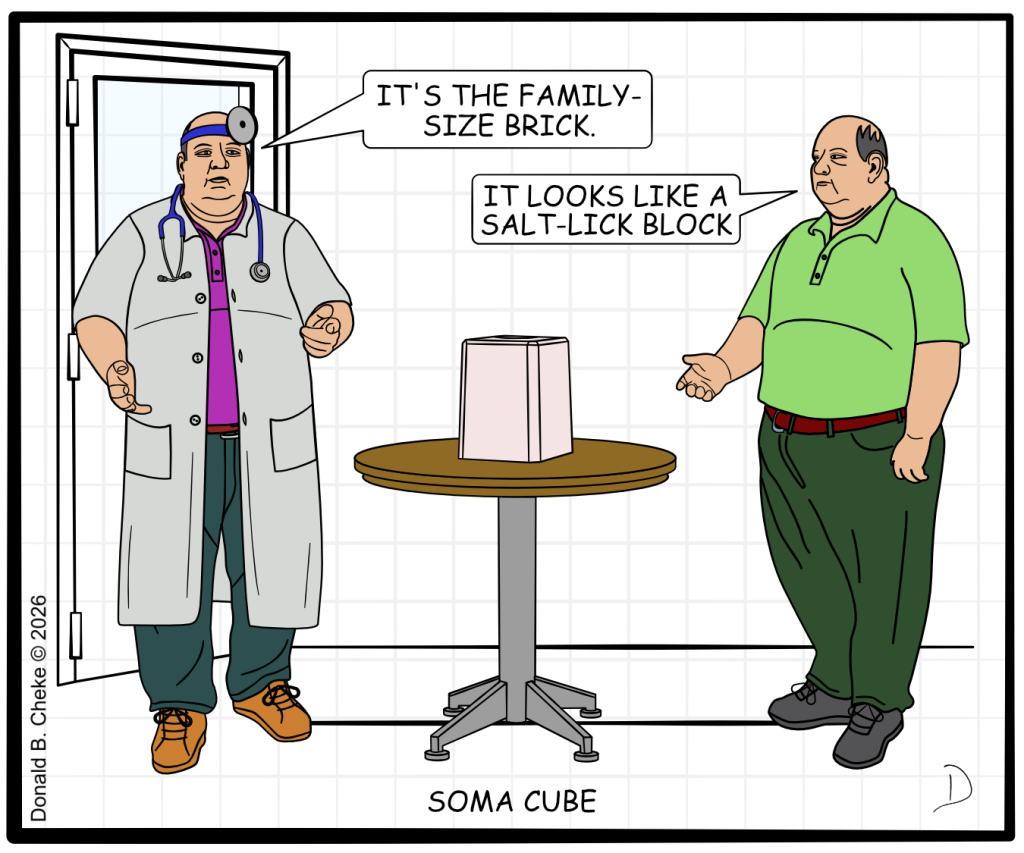
Soma Cube – Created by Don Cheke
Do you remember the Soma Cube? It is a 3D puzzle meant to occupy a person, keeping them focused on something other than their problems. I think of it as a vintage fidget toy. 👍😊 In the cartoon above, I have brought it all together — a block-like lick containing soma (or Citalopram) — enough for the whole family!
For those interested, it is my understanding that Soma is based on an actual ancient, sacred ritual drink from the historical Vedic religion of the early Indo-Aryans in India. Who knew!
Thanks for spending a bit of time with me today! Donald B. Cheke – Saskatoon, SK