
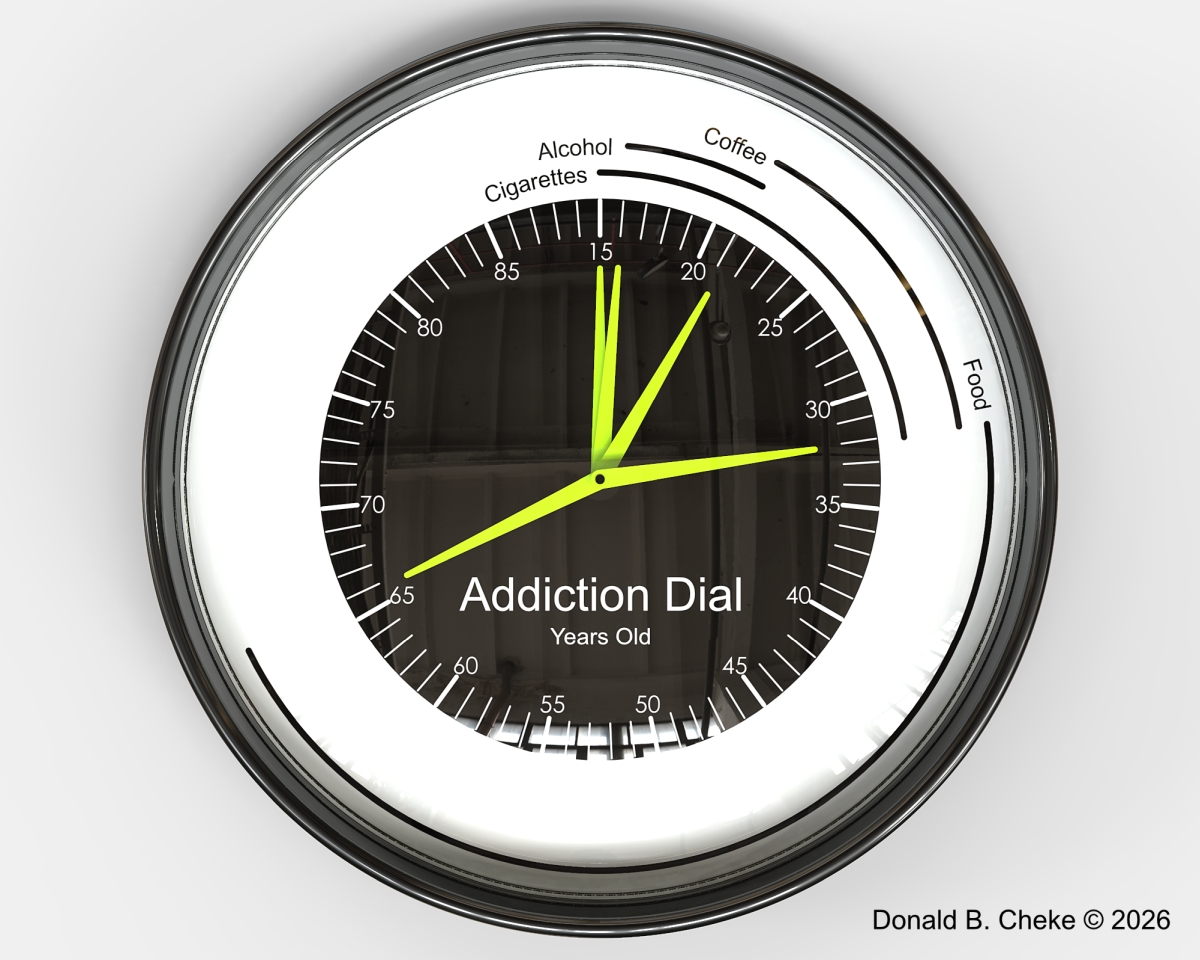
I hope that you aren’t getting tired of hearing so much about my mental and physical health these last few months, but so much has happened that I can’t stop talking about it. If you recall, I started making changes earlier in the year when I embarked on online therapy classes and wrote much about them in several blog posts. Later, I began to deal with my physical health, which is now on a very nice upswing in many ways.
Today, I am going to focus on my years of addiction, and then I will wrap up with my Ozempic journey and the positive results I am experiencing.
As the blog post title suggests, I feel like I am finally at a point where I am addiction-free. To help paint a fuller picture, I will list my various addictions and explain when and how they affected me.
The addiction dial in the feature image shows my progression through these addictions. I start the dial at age fifteen (1975) because that is where I can clearly see how it all started and progressed. As you can see, my first addiction was to cigarettes. By age fifteen — sixteen for sure — I was already smoking two packs a day (25 cigarettes per pack). Reaching for my smokes was my first action every morning, and I had one lit almost every minute of the day that I could. Of course, I was not able to smoke while in school, but I did make many trips outside to do so. In those early years, smoking was allowed almost everywhere, so I was able to smoke at my after-school job at Safeway and virtually everywhere else. As a side note and a bit of a confession — and hoping the statute of limitations has run out — many employees, including me, would steal cigarettes from the store. We worked late, after store hours, so grabbing a pack or two after work was easy. Doing so made up for the limited hours we were given at work, or so we rationalized.
In 1978, I had surgery and spent a number of days in the hospital. Smoking was allowed at that time, and I chain-smoked while in bed. I had a skull-shaped ashtray that became a conversation piece with nurses and doctors. Picture doctors telling me about the evils of smoking while they have a pack clearly visible in their pocket.
Over the years, cigarette smoking became less socially acceptable, and boy, did I hate that. I usually flouted the new rules, but not without some guilt and shame. There did come a point years later when I realized that I was owned by the tobacco companies, but quitting seemed an impossible task. In or around 1990, I tried to quit smoking by going cold turkey, as they say. I lasted one week before I couldn’t take the stress of withdrawal and started back up. I just figured that I would be one of those people who would not be able to kick the habit.
In October of 1992, I was working at a commercial cabinetmaking shop and had an accident that left me with missing fingers. At this time, smoking at the hospital was relegated to a separate smoking room, so right after surgery, I made my way there. After one or two puffs, I thought I was going to die from dizziness and nausea. I thought to myself how insane it was to be so addicted to these things that I would put myself through that just to appease an addiction. It was then that I decided I would smoke no more, that I would never do so again. I was already in horrible discomfort from the finger amputations, so I figured a bit more discomfort wouldn’t make much difference. To make things a bit more manageable, I did have my doctor prescribe the nicotine patch, a quit-smoking aid that was gaining much popularity. I completed the course of patches as prescribed, and I am sure that helped greatly. But as I said, even before starting the patches, I knew that I would never smoke again — and in fact, I have not.
As many users can attest, cigarettes and alcohol make a great pair, and I took up the alcohol banner when I was sixteen. For the first three years, I drank for the same reasons many young teenagers did — because it was cool, because it was a way to be grown up, and because it was a way to rebel against authority — if only in the abstract. Once I finished school and became part of the full-time working world at Safeway, I found that I gravitated to nightclubs and bars after hours, always with the intent of having fun. It just seemed to be the thing to do. It was a very typical experience for people my age, but it was also a time when things could take a more lasting turn in the wrong direction. In the last two years of my drinking days, I began to have more car accidents due to drinking and driving, and I got more and more confused and depressed. I was a sad drunk — the kind that gets teary and full of self-pity. I also suffered much guilt because I could see that others were taking notice of my drinking and poor behavior at work — just as my family was on the home front.
In a very short span, I hit bottom after several incidents in rapid succession. The first was an accident where I knocked down thirty or forty feet of fence with my truck in the yard behind the building where I was living. Next, after an evening of drinking, I decided that I would run away to Texas. As I was heading down the highway that winter night, I hit a patch of ice 100 kilometers outside of Saskatoon and ended up sliding through the roadside ditch and into a nearby field. There were loads of snow, so my truck was stuck up to the top of the tires. I flashed my headlights a few times in the hope that someone would notice, but to no avail. After a while, I gave up and passed out. I am not sure how long it was before a semi-truck driver stopped and came banging on my window. He gave me a ride to the nearby town of Davidson, where I got a hotel room for the night, dreading what lay ahead of me the next day. When I got back to the city the next day, I had to face my mom, who helped pay to get my truck towed back to the city. I also had to give some thought to work, because I had not gone in that day and hadn’t bothered to let them know I would not be there. I found out later that they had spent the day trying to locate me. When I went to work the next day, I explained that I had been having some issues and that maybe I should quit my job. To my surprise, the manager said that maybe I should quit. For some reason, I had penned my notice the day before, so I pulled it out of my pocket and handed it in.
So, what does a drinker do when his life is a mess and he has quit his job? Well, he drinks some more and tries to sort out his mess. As it turned out, getting a new job wasn’t that difficult. One of the bartenders I knew told me that her sister and brother-in-law, who owned and ran a dairy farm outside the city, needed a herdsman. They hired me after a brief interview that I don’t recall, and I was all set to go after I finished my last two weeks at Safeway.
A short while before I was to leave for the farm, I was out driving my brother’s car and drinking at the same time. I was stopped by the police and charged with driving while impaired. After being photographed and fingerprinted, I was let go, with the expectation that I would face a court date in the near future. After I left the police station, I went to a party that I knew was in progress, and while there, I gave some thought to my situation. At some point, I figured out that I was turning out to be my father, fulfilling the prophecy that others had predicted. I decided that I didn’t want that and that I would drink no more. With the exception of a couple of minor slips in the first year after my time at the farm, I have stuck to being alcohol-free.
Having lost my license, I had to sheepishly ask if I was still wanted at the farm. Thankfully, I was welcomed anyway and spent a great year and a half there, staying sober and getting ready for the new phases of life that would come. In case you were wondering, I left the farm because the wages were pitiful and because my allergies made living there quite intolerable. I knew I had allergies going in but thought I would adapt. Nope — I guess it doesn’t work that way.
All in all, my years of drinking were not that long, only about six years in total, but had I stayed on that road, I am sure I would have become a full-blown alcoholic. Was I addicted to alcohol, you might ask? I don’t believe I was. I was just a troubled person looking to kill the pain. As I found out, drinking just added to it, making life less manageable by distorting reality, and not in a good way. That said, alcohol was a problem for me, and I am happy to be rid of it.
I should note, too, that a long-time AA member I knew, who used to sponsor many AA members, told me that he always suggested that they give up smoking ten years after they quit drinking. He suggested that by then, they would have enough recovery behind them to help tame this next beast. Interestingly enough, I quit smoking about ten years after I quit drinking. But for me, it was just a coincidence — or was it!?
On a funnier note, although cigarettes and alcohol make for a great diet aid, they create a whole host of other problems. This will make more sense when we look at the remaining addictions.
When alcoholics (or users like me) quit drinking, they need something else to fill the void. If you went to an AA round-up back in the day, you will know that the replacement was coffee and cigarettes. Cigarettes were almost always a preexisting addiction, since they went hand in hand with drinking, but coffee replaced the alcohol, in part because it was a stimulant and provided a high, and in part because it felt like it filled the void or tamed the discomfort it brought. Temporary relief from discomfort, in its simplest terms.
Before I met Denise and married her, I had moved back to the city and started to frequent my old haunts — a bar called The Cork and Bottle and a lounge called Lorenzo’s, places where drinking still occurred. This was when I had two minor slips back into drinking. One was a single drink to appease another alcoholic who kept trying to make me drink. The other was when I was confused by my life situation, which seemed to be sending me backward. That time, too, was just a single drink, with the threat of drinking more — like one sees in the movies with struggling alcoholics. Still, I was determined not to drink alcohol, so I had coffee when I went to the bar and lounge — pots of it — enough to earn the nickname “Coffee Don.” Bartenders never charged me for my coffee, so when I left a generous tip, it went into their pockets.
Outside of the bars and lounges, I continued to drink coffee in a fashion that resembled addiction. Whenever I felt withdrawal (the void), I would light up a cigarette and pour myself a coffee. What a sight I must have been.
It must have looked strange to the regulars at The Cork and Bottle when I got married and quit going there. I can just hear them saying, “Oh, he’s whipped now,” or some other archaic thing men would say. LOL!
Denise and I still visited Lorenzo’s from time to time because our friend Mike worked at the attached fine-dining restaurant, and we still had other friends who worked there, like the gal who got me the job at her sister’s dairy farm. Both Denise and I remained alcohol-free, although alcohol had never been a problem for her.
Coffee drinking and cigarette smoking came to an end together when I decided to give up the “ines,” as I called them (nicotine & caffeine in case that wasn’t obvious). That, of course, was in 1992, at the age of 32, when I had my accident and decided I had had enough of the addictions. True to myself, I have remained free of coffee, cigarettes, and alcohol. I do drink weak tea (Earl Grey, hot), but usually just one cup a day, which Denise makes for me most mornings. I do not, in any way, feel addicted to it. She sure makes great tea!
With those addictions behind me, but still suffering from the effects of the void, I moved on to food for comfort. For me, it became the next best filler after giving up smoking. When eating gets out of hand, as it did for me, it is not so easy to kick the habit. Unlike cigarettes or alcohol, food is something one cannot give up completely. I thought of my reliance on food as a way to fill that psychological void, but it was also something I could not live without.
Because I continued to feel the void I have mentioned so often, food became the only thing I could use to squelch the feeling of withdrawal that came many times throughout the day. As much as I hate the saying, I became one of those people who lived to eat, as opposed to someone who ate to live. I always had food on my mind — always planning what groceries I was going to buy and what snack I would eat next. I kept a mental list of the foods that provided the best “love” factor — the ones that brought the most comfort. As a result, I got fat and continued to grow day by day. Some days, I could actually feel or see that I had grown. Talk about living with “crazy.” Over the years, I tried to diet, but that only worked for short periods of time and always failed at some point. For me, dieting was always about deprivation and self-castigation for having such poor willpower. It’s a no-win enterprise, in my opinion.
On October 1st, 2026, I took my first shot of Ozempic to help lower my blood sugar levels — to control my diabetes, as it were — and to help with weight loss as an added benefit. Within a few hours, I felt the food noise in my mind lessen significantly. I felt full for the first time in my memory, like the void was finally filled. It’s hard to explain to someone who is not familiar with this void business, but it is very real.
After six weeks, I am still in the process of increasing my dose to the prescribed amount, but I have felt very little of the void or the deep hunger. In the last day or two before my next weekly injection, I can feel a few minor stirrings. But as I said, they are minor — just enough to remind me of the difference I have felt while taking the medicine.
With the void — the hunger — finally gone, I feel so much more content. I feel like my true self, which is just an easy-going, calm guy. I must say that I like how that feels.
What I notice with Ozempic is that the “full” feeling stays with me so much longer. It doesn’t feel like dieting because, for me, it isn’t. The desire to eat simply isn’t there, so I don’t feel deprived.
The one thing I find very strange is that I find myself eating less often, so many things that I once ate get left out or forgotten — there simply isn’t any need or desire for them. This seems to leave a lot of time for other things, time that might otherwise have been spent eating or preparing to eat. A strange feeling indeed!
When I do feel hungry, I worry that my new medicine is not working well. Realistically, I think I am still adjusting to this new me and feeling hunger now and then doesn’t necessarily mean the medicine has stopped working. It will just take time.
At one point, I wondered whether Ozempic might have helped with my other addictions, like coffee and cigarettes, if it had been available to me many years ago. I don’t know the answer, but it is something I have wondered about.
One thing I thought about while preparing this blog post is how much the research into things like cancer, Parkinson’s disease, and diabetes can mean to people. My own positive experience with Ozempic has given me a new appreciation for that research and the benefits it can bring.
As with my other addictions, I feel like I can now say that my food addiction is over. I have great hope that the medicine will continue to be available and that I will continue to feel the benefits. I should note that my blood sugar levels have already dropped two full points since starting Ozempic. As another side note, I asked Copilot whether Ozempic acted directly on weight loss. The answer suggested that eating less was a major part of it. That seemed to fit with what I was experiencing, although I would leave the medical explanation to my doctor.
On a bit of a different note, I do feel a bit sad that I have been having such great success at overcoming my physical and mental issues while my wife, Denise, continues to suffer more and more from her Parkinson’s disease. It seems so unfair that she cannot find a cure or great relief from her debilitating disease. I hope that continued research will bring her, and others in her situation, more relief.
Well, that seems to be the end of addiction for me. My hope is that I can continue addiction-free for the next twenty to twenty-five years, and that I will keep wanting to, since this new me is much happier to carry on. I also hope that I will benefit from much more weight loss, but only time will tell how well that goes. So far, so good!
Thanks for taking the time to share in my journey.
Donald B. Cheke – Saskatoon, SK
Great blog Don! Brings back a lot of memories…the fence, your time out at the farm and my visits there (Heard Health, pulling calves!!) and your visits to the hotel. I also remember your visits to the KG Hotel lounge when I was there too. It has been a long journey and you have done well. Happy to have been a part of it