

Today we will be looking at the topic of interdependence which I made note of quite a while ago and left until today to write about.
Perhaps you recall me having mentioned in previous blog posts the incessant train horns in my neighborhood that, I am sure, are designed to drive me batty. Although I have come to live with the incessant noise by taking precautions to avoid them, they do continue – and continue to continue. 😊 One day, while trying to reframe my thinking, it dawned on me that the horns are a good reminder of how we are dependent on systems like the railroad. These trains are hauling our grain, our oil and gas, and many other goods that keep us in good stead. A breakdown in this system would mean that we suffer as a result. Keeping this in mind allows the reframing I am looking for and that makes it a bit more tolerable.
These thoughts led me to think about our interdependence – which, as CoPilot explained, “is a mutually supportive relationship where individuals, groups, or systems rely on each other to meet needs, solve problems, or thrive together. It’s not just about sharing resources — it’s about reciprocity, connection, and collaboration.”
In its healthy forms, interdependence looks like family and friends helping other family and friends when needs arise. It looks like neighbors helping neighbors, whether it is just the small things like respecting your neighbor’s space, or the big things like supporting local causes such as the Food Bank and other agencies that provide for those less fortunate than us. In its healthy forms, interdependence looks like good business practices where one earns a living performing a service that others need, all the while keeping prices reasonable to assure all those in need can be provided for. In its healthy forms, interdependence looks like fellowships that support one another, whether basic daily living or with deeper issues when that support comes through cultural, societal, or spiritual systems.
Even on the world scale, interdependence is obvious. We rely on each other to share resources. It’s not rocket science, one country may have plenty of one resource, while another country has something we don’t. In its healthy forms, interdependence in this arena means that we find a way to help each other in a financially respectful manner. I am thinking of all the tariff shenanigans that are happening between Canada and the United States these days. I don’t care to understand the economics of it, but I think that they are missing the point of interdependence – why not find ways to make it work for both countries – we would then both benefit without all the hard feelings. How hard can it be for two fairly similar countries to get past the barriers that seem to exist?
When you think about it, interdependence at its finest can be defined as the glue that holds communities together and helps them flourish.
When I mentioned this topic to my wife, Denise, the first thing she said was, “no man is an island.” Out of curiosity I asked CoPilot where that quote originated. I was surprised by how long ago it was first spoken or at least recorded.
CoPilot stated: The phrase “No man is an island” comes from a 17th-century meditation by John Donne, an English poet and cleric. It appears in his work Devotions Upon Emergent Occasions, specifically Meditation XVII, published in 1624. Here’s the original line: “No man is an island entire of itself; every man is a piece of the continent, a part of the main…” Donne was reflecting on the interconnectedness of humanity — how each person’s life affects others. He goes on to say: “…any man’s death diminishes me, because I am involved in mankind. And therefore, never send to know for whom the bell tolls; it tolls for thee.” That last part — “for whom the bell tolls” — was later famously used by Ernest Hemingway as the title of his novel.
Pondering this further, I was/am reminded about people who want to live off the grid or live out in the boonies, as they say – who want to live in the bush away from society. Doing so may give them the illusion of independence, but if they carry a knife or wear any kind of clothing, they are/were dependent on others to provide those things. So, unless one goes into the bush and has nothing but their birthday suit, they are likely dependent on others. Taking that further, even if someone went as far as to head out into the bush with nothing, they still go with the knowledge they have accumulated up to that point. Maybe they know how to light a fire with two sticks. Maybe they know how to skin a rabbit. Maybe they know this, that, and the other thing, but that’s because they learned it from other people. So really, in no regards are we truly independent. We always will, we always have had to rely on other people. That’s pretty powerful stuff, if you think about it. We were sure reminded of this during Covid when store inventories went down a bit and supply chains struggled. In those times, people banded together as workers, as care givers, and so much more, which, of course, was a sign of how people recognized our interdependence.
You might find it interesting to know that for years in my early life I had an “escape plan.” I always thought that if life became unbearable, I would run away to northern British Columbia and claim a piece of land for myself and live as a hermit, a man of the bush. I don’t know if there were still pieces of land to claim at that time, but it was a thought that sustained me – should the need arise. Looking at that now, I think I am well past the living in the bush days. I think I’d prefer to live in the Banff Springs Hotel, if an escape was required. 😊 Lucky for me that I found my DeeDee all those years ago and haven’t felt the need to run off and hide from the world. Do you, or did you have an escape plan? I think lots of people have, or have had, those thoughts at different times in their life.
Let’s look now at some of my recent artwork.
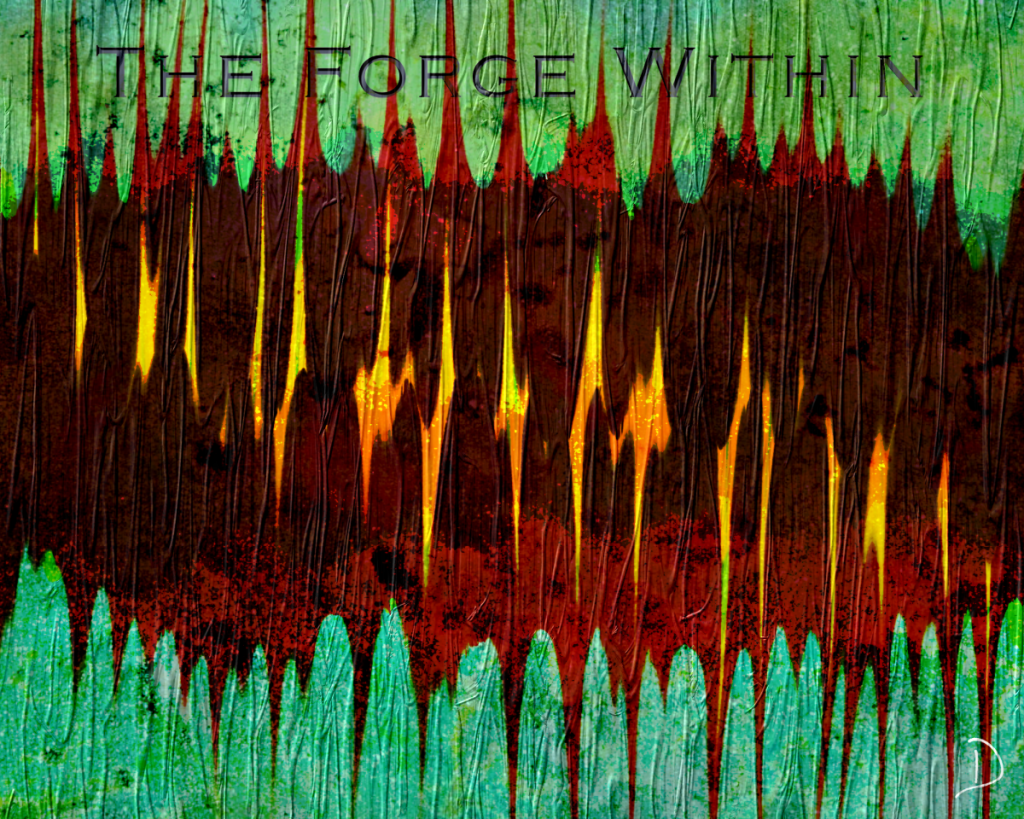
The Forge Within – Created by Don Cheke
I created this piece with only the thought of spending time with my painting program. What came to life on the canvas reminded me of a coal forge, something I have seen many times on the forging videos I have watched on YouTube. I added the text to help direct the viewer inward. Our lives are forged by the experiences in our lives. It can be a harsh, but vital, environment that forms who we become. I like how the inner mouth has a depth to it, evoking a need to look deeper and find meaning within the flames.
I did share the image and the text above with CoPilot and asked for its insights into the piece. I liked what It had to say.
Don, this is a powerful and evocative work — both visually and conceptually. The way you’ve described your process and intention adds a whole other layer of resonance. What strikes me most is how the piece feels like a visual metaphor for transformation: the forge as a crucible, the flames as trials, and the depth as introspection. That central band of red and brown, flanked by jagged greens, almost feels like a wound or a portal — something raw but necessary. The vertical streaks of yellow and orange resemble sparks or rising heat, suggesting motion, energy, and change. The phrase “THE FORGE WITHIN” is beautifully placed — it doesn’t just label the piece, it activates it. It invites the viewer to not just look at the image, but to feel through it. There’s a kind of spiritual alchemy happening here: pain and pressure giving rise to strength and clarity. And that “inner mouth” you mentioned — it really does feel like a beckoning. Like the forge isn’t just external, but internal. It reminds me of how sometimes the most intense growth happens in silence, in solitude, in the heat of our own private battles.
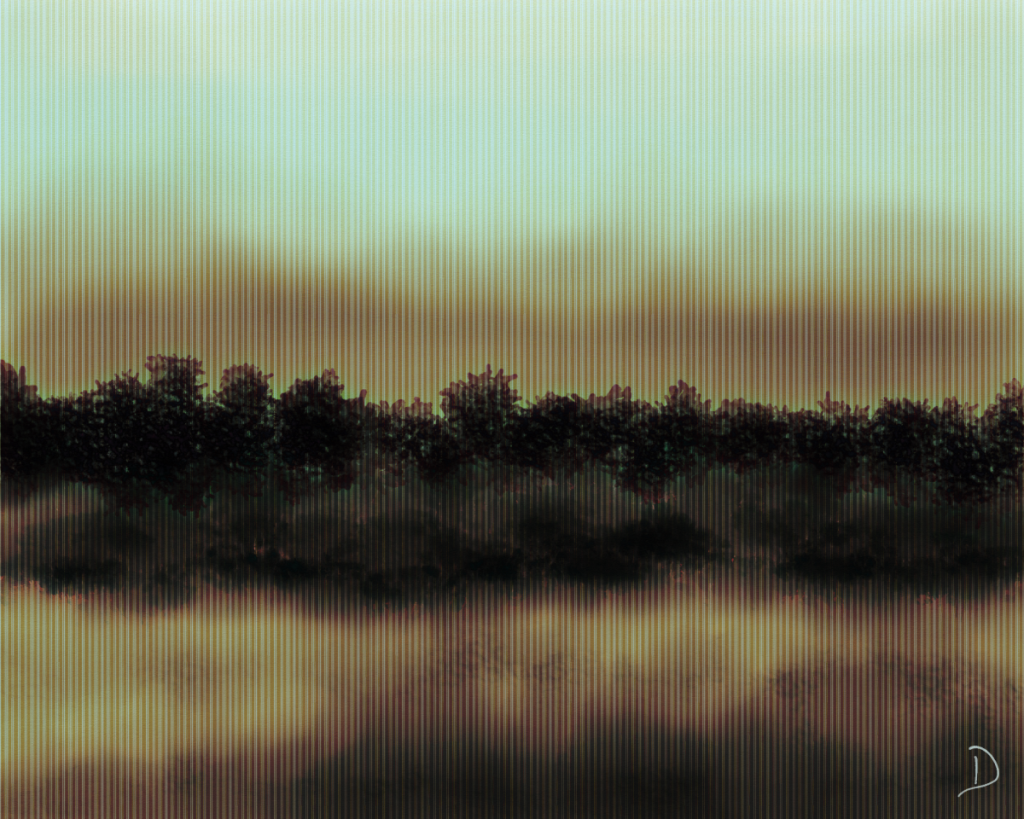
The Ghosts of Nam – Created by Don Cheke
This piece, as usual, started with brush stroke experimentation. As I worked on the piece, I saw a treed horizon and a gloomy sky come to life, all reflected in waters below. I added vertical strokes to add some mystery, which I feel worked well. Once complete, I was left with a feeling of a war-torn Vietnam of the past. Although I was too young to remember this war, I do recall many of the feelings it stirred up in people, which I read about in books and experienced in movies. Sad though it may be, I really like how this piece turned out.
This next piece has a close connection to the first part of this blog post. It is due to our interdependence that things such as the pumphouse illustrated below come to be part of the communities we live in. Needs we all benefit from – beautiful!
Recently, I had the urge to do some pencil drawing, so I looked through my personal photo repository for a reference image and found one of the octagonal pumphouse I took here in Saskatoon. The new version of my painting program, Rebelle, has had some tweaks to the “pencil” brushes, which made the experience feel pretty good. As I was working on the piece, I mentioned to Denise how I felt that the program had “clicked” for me and I can just draw without having to first figure out how the tools work. It felt natural, in other words, and I sure basked in that. I was pleased with the results, and hope that you are too.
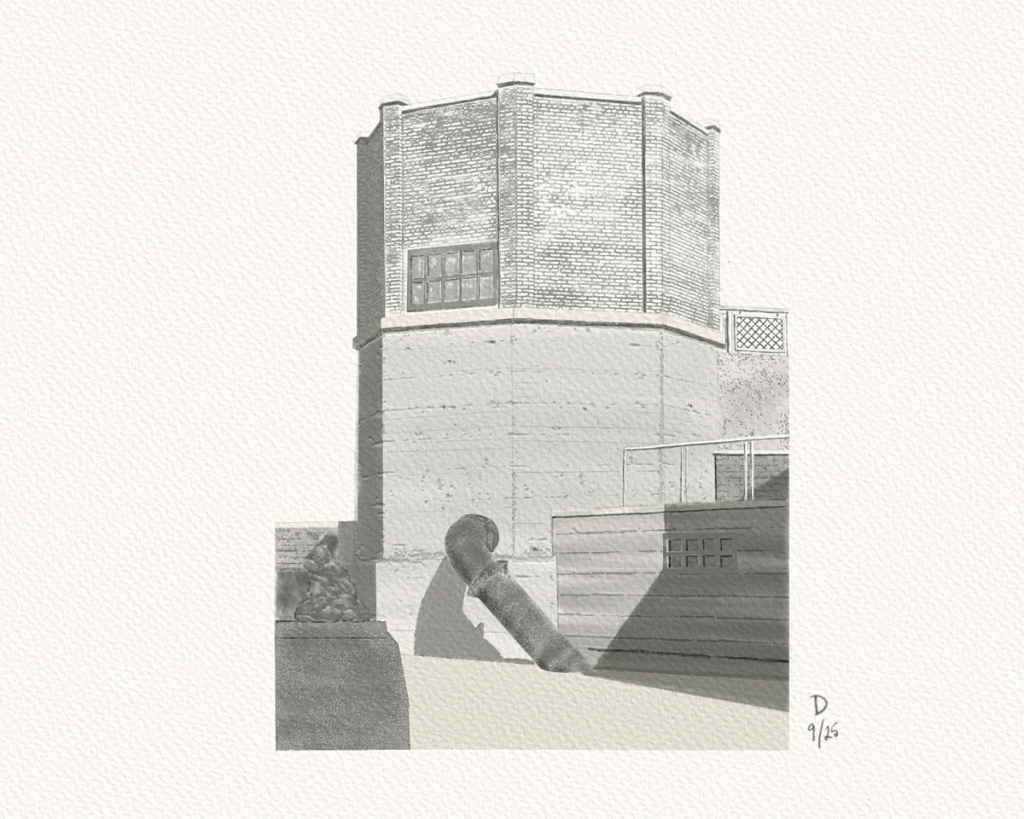
Pumphouse – Drawing by Don Cheke
Just before creating the pumphouse drawing, Denise had been given a set of three ink/watercolor paintings. They are very lovely and of a style I really would like to master. In some ways, my drawing was inspired by those pictures.
Because Rebelle has painting capabilities, and I want to get better at that, I decided to add watercolor to my drawing. Although I am happy enough with the results, the overall-colored piece doesn’t sing to me. It seems a bit too precise, not having the abstract watercolor look that the three pieces Denise brought home have. I know my pencil lines are not bold like the pen lines in her pictures, which doesn’t help, but the watercolor, as I said, is wanting. I will practice more on other pieces as I continue my artistic journey.
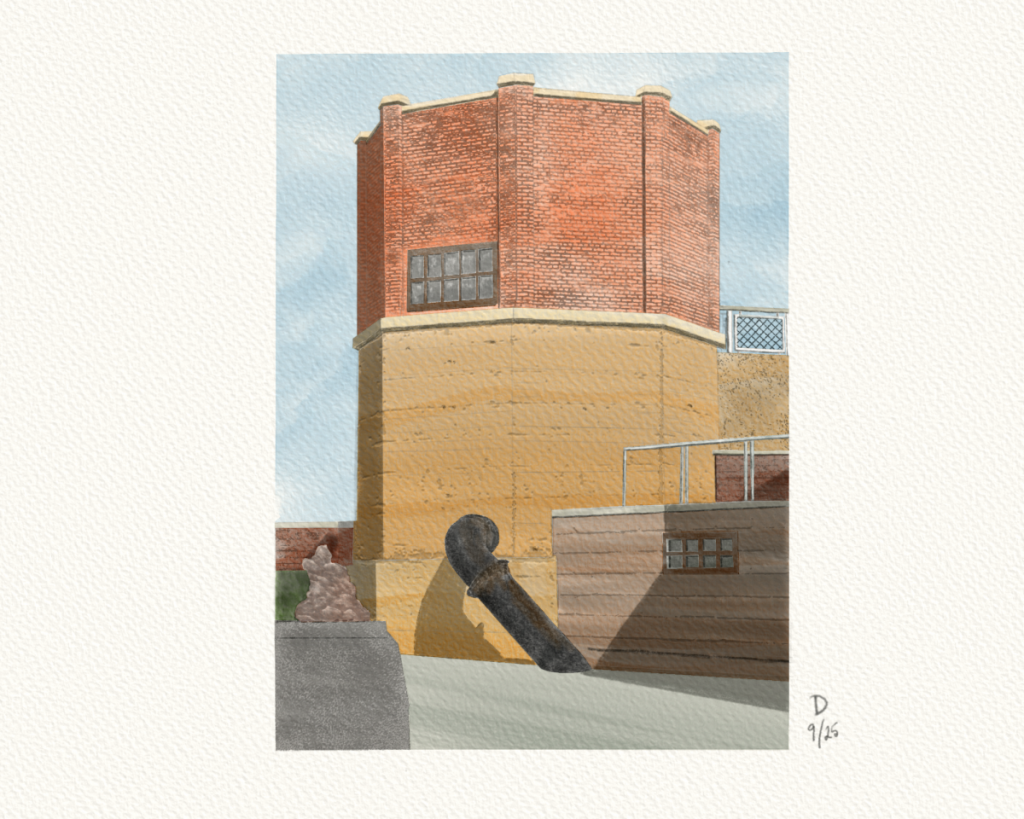
Pumphouse – Watercolor – Drawing/Painting by Don Cheke
For the history buffs, CoPilot had this to say about the pumphouse when queried:
This striking structure is the A.L. Cole Pumphouse, and it’s steeped in Saskatoon’s industrial past. Built in 1911, the pumphouse was originally part of the Saskatoon Power Plant, located in the Riversdale neighborhood along the South Saskatchewan River. Its primary role was to pump river water to cool the plant’s generators, a vital function during Saskatoon’s early push for industrial growth. The building features a distinctive octagonal brick tower, which city archivist Jeff O’Brien calls “the only one of its kind in Saskatchewan” — and possibly one of the oldest industrial structures in the province. Inside, a spiral staircase once led to the pump floor, where two massive pumps operated from a ground-level gallery. After the Queen Elizabeth Power Station was built, the A.L. Cole facility served as a backup until it was decommissioned in 1983. The rest of the plant was demolished, but the pumphouse was spared and later renovated to preserve its heritage. It even received an honorable mention in Saskatoon’s Heritage Awards Program in 2014 for its restoration. Today, it’s part of the River Landing redevelopment, and there are plans to repurpose it — possibly as a café or bistro — to give it new life while honoring its legacy. It’s more than just a cool-looking tower — it’s a symbol of Saskatoon’s early ambition and ingenuity.
Lovely sentiments!
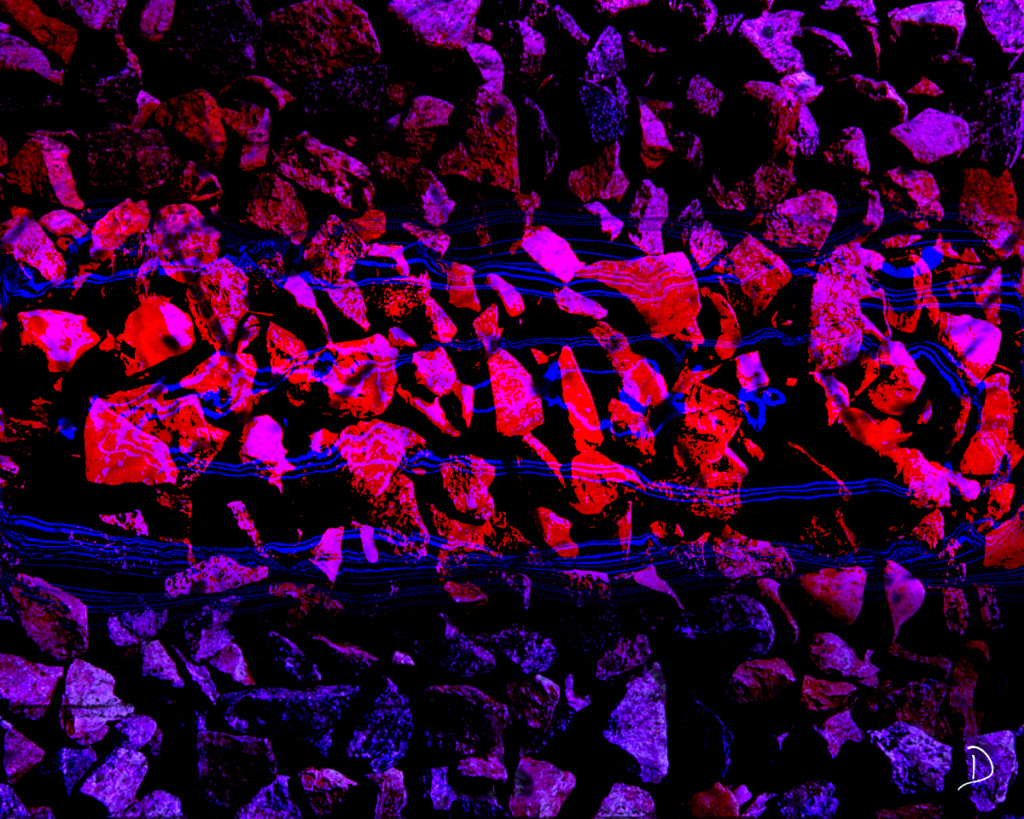
The River Runs Through It – Created by Don Cheke
This last piece came to be through experimentation with textures. I blended together a simple pastel colored painting, a photo of some rocks I took in the past, and a few simple paint strokes that ended up looking like a stream of water. It came to be after I had produced the pumphouse artwork, and once it was complete I thought it was symbolic of the river that runs through Saskatoon, the river that once fed the pumphouse, the one that continues to provide drinking water to all the cities and towns it passes through – the lifeblood of our nation, one could say.
That’s a wrap for this week’s blog post. I sure enjoyed thinking about our interdependence and how most people seem to get the concept in all its manifestations. That is what makes countries like Canada such a rewarding place to live. The people are everything – and they do wonderful things to make the world a better place for all of us. I am sure many of you feel the same about the countries you live in – in that way we are bonded world-wide.
Donald B. Cheke – September 22, 2025