
In today’s blog post we will deep-dive into Lesson 4 of the Online Therapy Unit. We will also look at two new comics and then reflect on some vintage icons we are all familiar with.
April 13, 2026 – April 16, 2026
Due to the vulnerability of what I share below, I almost talked myself out of creating this blog post. I had Denise read what I had written and she said that if I was okay with the vulnerability that it would make a good post. She also said that it was a continuation of the course I had already been sharing, so it would likely be received in the same good manner.
This week, I noticed something that I wasn’t expecting to happen. I was working on lesson 4 of the Online Therapy Unit course and felt an urge to quit. It took me a little while to get into the new lesson and to figure out what they were talking about. Only later during the DIY component did it click for me. On top of all that, I received a response from my therapist that made me feel that she had not really taken the time to read the messages I had already sent her, since the questions she posed, I knew I had already answered in earlier correspondence.
To be honest, I am not sure that her response was the biggest factor in wanting to quit the course, but rather, it was how the material was stirring me up.
It seemed to be making me question everything I achieved on my journey to this point and I was feeling uncomfortable. The strange part is that how it twigged on me only much later how common this wanting-to-quit reaction is in recovery. I am thinking about Al-Anon where in the beginning, one starts to look at the immediate issues and wants desperately to get out of crisis. In the beginning, one sees the crisis they are in, can even admit that they are powerless and that their life has become unmanageable.
Once the crisis is settled one can start working the steps and start digging deeper into what is causing the issues – both externally and internally. That is good, and as it should be. Perhaps one works through the 12 steps and has seen much growth in themselves. Using the onion analogy, this is the first layer peeled away. For those that continue to look deeper, right below that layer is another one that needs to be looked at, stuff they might not have seen earlier due to all the protective behaviors they had learned before arriving at Al-Anon. Those that stay in the program take on the new challenge – maybe it requires doing the 12 steps again, and maybe reaching out for additional help, such as with a counselor where much more in-depth work can be done. For those in the program, it is not unheard of to encounter many more layers after the first two.
So, what happened in Lesson 4 for me is that I was reminded that I need to dig deeper on the next layer which includes a look at noise, fear, judgement, and injustice – all coupled with anger. Although I have been aware of these things and even taken steps to deal with them, I think that I have been just holding station with them for quite a while. That is acknowledging them but not taking further steps to tame them. As I said to Denise, I have been trying not to pay too much attention to them, but do notice that they are influencing my life, and not always in the best way. I want that to change.
Lesson 4 Presentation – Thoughts and Comments
Lesson 4 looks at Behavioural Symptoms associated with anxiety, stress, worry, depression and low mood – as well as strategies for managing them. The Online Therapy Unit suggests that there are a couple of things that sufferers do if they are not managed. One is avoiding things that cause symptoms and the other is developing safety behaviors to help one cope.
At first, I thought there wasn’t much I related to or had to deal with, but it didn’t take long to realize that this was not true. As I read, I thought about some of my behaviors that cause me grief quite often.
Below is a list of things that are stressors for me, along with what I do to avoid them or behaviors I use to keep myself safe. I will also mention what I would like to achieve with this lesson with regards to each. Note that I am making notes as I am reading the main presentation, so some things may be covered the further I read.
I’d like to note that although I have the stressors below, I have made great strides in dealing with them over the years and like to think that I have come a long way in managing them. Still, I have a long way to go.
Noise
Noise causes me stress daily. I encounter it all around me and I react with anger if preemptive steps are not taken to keep from encountering it. Not in any order of magnitude, they include train horns, backup beepers, wind chimes, loud voices, other people’s phone noise – be it them talking loudly into it or them listening to anything audible like videos. Others include barking dogs, loud car and motorcycle mufflers, racing engines, thumping music from passing vehicles, cawing crows, music playing during narration in videos, crowds, loud groups of people in restaurants, and many more that elude me at this moment. All the noises mentioned set me on edge, they invade my personal space where my preference is quiet solitude, or respectable noise, which seems to be a foreign concept in modern society.
What I do to temper or avoid the noise is wear earplugs when I sleep, or keep them in upon waking, as I know that the moment I take them out, the next nearby train will be blowing its horn like the engineer has nothing better to look forward to – or the morning school bus will be idling outside my window as it does every morning while warming up. If I keep this solution in place upon waking, I can make it through until I get my earbuds or my headphones on, thus enjoying my own sounds, as opposed to theirs. As much as I like my music, I hate being forced to wear my headgear all day long to keep me sane. When I go out, I always take my earbuds as I know I will encounter endless noise of every kind. It is a stressful time if I ever forget my protection! Anger is the result!
I also avoid things that I might otherwise like to participate in. A recent example is from this OTU course. There is an introductory video at the start of each lesson. The videos are typically three to four minutes. I simply can’t watch them because there is music playing loudly as the narration takes place. The music overshadows the narration and makes me feel that familiar insanity that I avoid in many YouTube videos I would have otherwise liked to have watched – but can’t due to this huge annoyance. It is the same intrusion I feel with ads in media, and the doom and gloom in news. I have often joked with Denise that I would like to live in a concrete bunker in the middle of a large field – no neighbors for hundreds of miles, or just over the distance noise can travel, whatever is less.
What I’d like to achieve is the ability to face the noise without it making me crazy, but I certainly don’t want to intentionally expose myself, as it would seem more like sticking one’s hand in a fire to get over the fear of fire.
While thinking about noise, I was reminded of a traditional Yiddish folktale called, “It Could Always Be Worse.” The tale was popularized by Margot Zemach’s 1977 Caldecott Honor book. It tells of a poor man living in a crowded, noisy one-room hut with his family. Seeking peace, a rabbi tells him to bring his animals inside, making life unbearable until the animals are removed, revealing that things could be worse.
Key Details of the Tale:
- The Conflict: A poor man lives in a tiny, one-room house with his wife, his mother, and six noisy children.
- The Advice: The man complains to his rabbi about his miserable, cramped life. The rabbi advises him to bring his chickens inside, then later the rooster, then the goat, and finally the cow, escalating the chaotic, crowded conditions.
- The Lesson: When the man can no longer handle the chaos, the rabbi tells him to remove all the animals. The family finds their home now feels spacious and peaceful compared to when the animals were inside, teaching that perspective can improve a bad situation.
- Origin: It is a classic Jewish folktale often told to illustrate gratitude and to show that, regardless of a difficult situation, it is possible for things to be worse.
(Google AI credits many online sources for the information. Search the title for more info.)
I’m not sure I want to invite the chickens in. Can’t I just use the tools I have to avoid the noise? Still, I would like to avoid the anger when it encroaches on my space and my solitude. In other words, take precautions, but not overreact when they do.
Fear
Fear was our family motto growing up. My grandmother was insanely fearful and she reacted and lived with fear throughout her life. She married into abuse and eventually spent time in a mental institute on more than one occasion. She was exposed to the early tortures of those times where things such as electroconvulsive therapy (ECT) and brain-numbing drugs were used. My mom and uncles, growing up in that home with a verbally abusive tyrant of a father and a completely beat-down mother, took on and used many of the coping skills we can imagine. Although my mother found recovery, she still brought along her own brand of fear, which I learned in my own way. Fighting fear has been a life-long battle for me, but I believe that I have come out as the winner most times. I do, however, see it lurks in the periphery, occasionally making insteps right into my day-to-day routines. I remember many years ago coming across a book called Hinds’ Feet on High Places by Hannah Hurnard. It told my story.
If you are not familiar with the story, ChatGPT offers this brief summary.
“Hinds’ Feet on High Places” by Hannah Hurnard is a short allegorical Christian novel about spiritual growth. It follows a fearful, physically deformed girl named “Much-Afraid” who lives in the “Valley of Humiliation.” Longing for a better life, she sets out on a journey to the “High Places” with the help of the Shepherd (a Christ-like figure) and two companions, “Sorrow” and “Suffering.” Along the way, she faces difficult trials – deserts, cliffs, and inner fears – but gradually learns trust, perseverance, and faith. In the end, she is transformed: her weakness becomes strength, her fear turns to joy, and she receives “hinds’ feet” (symbolizing spiritual freedom and stability), enabling her to live confidently and help others. (ChatGPT credits Wikipedia as its source.)
Although the story is an allegory of the Christian journey, it was more about transformation and spiritual maturity for me than it was about religion. I love the transformation that came over me through the years. I will always remember this book with fondness.
I really hate when I react with anger when I am faced with fear-inducing moments. Something occurred just the other day that set off this behavior. For reasons of privacy, I will not mention it, but it is not an isolated occurrence. If I look back over the years with Denise, I always react with anger when she faces a health scare. Although I do what is needed in the face of the crisis, such as racing her to the hospital, I am angry! I am angry that she is suffering. I am angry that our lives have been, once again, disrupted. I am angry that I am powerless to keep her from suffering, and I am angry at the god I don’t believe in for dumping it on her again, another burden she shouldn’t have to have.
I always get past the anger, but I would much prefer to react without anger, to do so with only compassion and love, and offers of assistance. My dear Denise does this every time she is faced with the same or similar type of crisis. The crisis mentioned in the last paragraph, Denise was in bed for the night, but as soon as the phone rang and she answered she was donning her clothes and ready to rush out the door to help. She showed no anger, just the love and compassion that she radiates. I want to be like her!
Being Judged
Like everyone else, I don’t like to feel like I am being judged. In this area, the only thing I fear being judged about is my weight. Most people don’t come right out say judgmental things, but that doesn’t mean it hasn’t happened. For years I would accompany Denise to visit her relatives in Alberta. They are/were nice enough people but one or two usually commented about weight. After the last time I experienced what I felt was a personal slight about my weight I decided that I would no longer accompany Denise when she went there. If I am not mistaken, Denise agreed that that would be best. Some things never change and I remember Denise coming home after a trip there on her own. It must have been for a funeral, and while riding with some relatives she was appalled at the disparaging comments the other passengers were making about overweight people they saw along the drive. When Denise relayed the story to me, once home, she said that she was embarrassed to be with them. As time passed, trips to Alberta became less and less, due to health problems and lack of finances, so it is not an issue any longer. The point is that I stopped going for self-preservation reasons.
I still worry about running into people from the past when I am out and about in Saskatoon, but luckily, I suppose, I usually only encounter those who know me as I am, and don’t judge me anyway.
I’d like to mention that I never let clinicians weigh me when I am at the doctor’s office. They can see clearly that I am overweight, and I don’t want to be defined by my weight. Refusing this basic practice has become easier over the years as doctors and nurses understand how many people feel about weight – that it is something personal. I would let them weigh me if it was vital, like before surgery where they need to calculate anesthesia, but I would have them do it without me seeing or telling me the number.
As with the other things mentioned above, I wish I could be less concerned with what others think about my weight.
Injustice
I’m sure I have mentioned this before, but when I see or feel injustice, I feel anger. For the most part, I just avoid the places where I might be exposed to this. That includes watching or reading the news. I figure that if I need to know about some crisis, Denise will tell me.
I find many stressors in my entertainment, whether in books or on TV, and I have to work hard at not letting it make me angry. Not so long ago, Denise reminded me that all good stories require one or more antagonists – that’s what makes the stories interesting, especially those where there is a battle between good and evil (in the generic sense) taking place. I have been trying hard to keep this in mind lately, and I think that it is working quite well – that it is keeping me calmer.
I don’t want to stop reading or watching TV, so getting better at remembering it is just a story is the key, at least that is what I hope.
Next in the OTU presentation is some discussion about dealing with things using graded exposure. That is just what it sounds like, gradually introducing fear or anger inducing stimuli and learning to acknowledge it and apply techniques to lessen the negative effect.
Do I want to expose myself to more and more noise to become accustomed to it? No! I will continue to use ear plugs, earbuds and headphones to block the noise. Is this an avoidance behavior? Maybe, but I think it is a healthy one. Do I want to feel less stressed by noise when I encounter it when not prepared? Absolutely! Instead of feeling angry, and complaining about it, I would like the ability to let it pass without the discomfort it causes me. Let’s hope that Lesson 4 can help with that.
The lesson describes three steps. Let me ponder this thinking about train horns.
Think of something one wants to stop avoiding. — Okay, I want to stop getting angry when I hear the train horn when I am not prepared – that is not having ear protection already on.
Rank the task. — Okay, let’s say it is hard, as opposed to easy, medium, hard, or very hard. It sparks my anger easily.
Pick an easy task they say. — I don’t know what this means. Does it mean I should leave the ear protection off and allow the train horn to blast away and just let it pass without getting worked up, or do I reframe what is happening in my mind, so it is no longer a negative? I know that when Denise hears the horns, she does not react badly, and when I questioned her about this, she said that the horn reminds her something good – a country living feeling, if I remember correctly. I know that I have tried reframing the horn noise in the past to be a reminder of the goods and services that a healthy, functional society provides – thus ensuring we are fed and clothed, or something like that. It makes sense, but the horns are insistent and never-ending. Three long blows at a nearby crossing six to eight times a day, and three more long blows down the line a short way with the same frequency, but not as loud due to the distance. It is a lot to deal with, and I don’t want to move locations. The only option is to be prepared, and when not prepared, accept it for what it is, and hopefully without the anger which only harms me, and Denise if she has to see or hear me react.
The more I read the OTU lesson, the more it seemed that they were suggesting putting the tasks/activities, or the things one wanted to get better at, on a stepladder, placing the easiest on the first rung and moving up each step with the next harder task. They suggest starting with an easy task and working up from there as one achieves success. Most of my issues or task have a similar level of difficulty, and it is so often about my reaction – anger as mentioned again and again. Maybe the key is to allow some exposure and actively work at reframing what I am up against, finding something other than anger to color my mood.
The people who shared their experiences in the OTU presentation mentioned many things they avoided in order to protect themselves, but I related to them only in the sense that if I had similar thoughts, I would just feel the fear and do it anyway, something I have become quite proficient with. Experience has taught me that it is always worth moving forward through the fear.
The remainder of the presentation looked at combining all the skills one has learned from all the lessons thus far. The key, in a nutshell, is to actively work at becoming aware of what is going on and using the tools to break the cycle that leads back to unhelpful thoughts, unhelpful behaviors, and poor physical symptoms. It’s a tall order, especially for those starting out, but it all begins with one step – and then another. I think I will move forward doing just that, but I will also actively work at not reacting with anger one incident at a time.
I just had a win, so to wrap up I will mention it now. One of the noises that makes me crazy is the howling wind noise that comes from under the door of our apartment. The halls are pressurized to keep resident smells in the suites. When we moved into the new building 4 years ago almost everyone used a self-installed draft blocker to stop the howling. In the first year, the fire department visited and told everyone that they could not do this, and if they continued to do so they would be fined $500. Like most residents, we removed our permanent draft blocker and started to use one secretly on the inside of our suite. The trouble is that it must be manually placed every time we go out and in. It is a hassle but saves us both a lot of grief. Today I left it off because Denise is out and I would need to move it to let her in when she comes home. I will often let the door stay open and flap in the wind but today I closed the door and left off the draft blocker as I knew I would be in my room with my headphones on. When I took my headphones off to go get a drink, the door, of course, was howling away. I knew it would be, so instead of getting angry about it, I just got my drink and opened the door to flap in the wind – but I did not get angry – I just took it in stride, as a sane person would. That is one small step for Don, and one giant leap for his sanity. 👍😊 I think the key will be to remember that it is not that big of a deal, and that I can just take steps to lessen my exposure and remain calm when I need to.
Lesson 4 DIY Thoughts and Comments
As I started to read the DIY material for Lesson 4 it dawned on me that I could use the graded exposure technique to overcome the stress I feel from noise and crowds. I think that if I put myself into a stressful situation, like standing on my balcony, with no hearing protection for short periods, I might be able to handle the noise without anger. Doing so intentionally will allow me to know that the stressors will be there, or come shortly, and will allow me to prepare mentally for it and focus more on facing it with patience – not letting it get the best of me.
I think the key is that I can be prepared, and even use hearing protection, but perhaps by getting more used to it, I can forgo the accompanying anger that is always a component – the piece that I want to stop having.
It’s funny too, how it is only in lesson 4 that I have come to see that I experience anxiety as well as depression, whereas I had entered the OTU course thinking my only trouble was with depression. Perhaps this is because I didn’t connect, until now, that my anger was a sign or a symptom of anxiety. It makes so much more sense now, like a light bulb just came on.
Developing an Exposure Stepladder is one of the key points using graded exposure to overcome avoidance and safety behaviors. I decided to give this whirl since it was finally making more sense to me. My biggest anxiety comes from noise.
STEP 1: Think of something you would like to be able to do.
I would like to be able to go outside without the noise making me angry.
STEP 2: Think of lots of similar activities, tasks and situations, and rank them from easiest to hardest.
Easy – Step out on the balcony for 5 minutes without hearing protection.
Medium – Walk outside for 30 minutes without hearing protection.
Hard – Go grocery shopping without hearing protection.
Very Hard – Go without hearing protection for a whole day.
STEP 3: Pick an easy task that you can do and do it until it becomes easy.
I could definitely try the easy item and monitor my reaction and try to understand what is happening with my mind and body. Why does the noise trouble me so? Maybe if I can figure out why I react so badly to noise I can figure out how to lose the anger. Maybe I will always need hearing protection, due to my unique hyper-sensitive hearing, but if I could lose the anger, that would be most welcome. I will certainly work at the exposure business, as that seems like a strategy that could work. Let’s see….
April 17, 2026
Today was the day when I decided it was time to visit Mr. Big & Tall. Since I didn’t want to go out in the snow that arrived in ridiculous amounts the night before, I decided to shop online. I purchased a package of underwear (3 for $40.50 with VIP discount) and 4 shirts ($112.00 with discount). All totaled just under $170 with tax. What happened to the days when you could buy 3 pairs of gotch for $5.99!? LOL!
Below are a couple of stories leading up to today’s shopping trip.
The other day when I was doing my laundry, I took my underwear and socks out of the dryer and brought them to the table to begin folding. As Denise often does, she came over and started folding the underwear to help with the task. Immediately she noticed that there was a couple with some significant rips. She said that I should get myself some new ones. I chuckled when she asked what people would think if I had been in an accident and taken to the hospital.
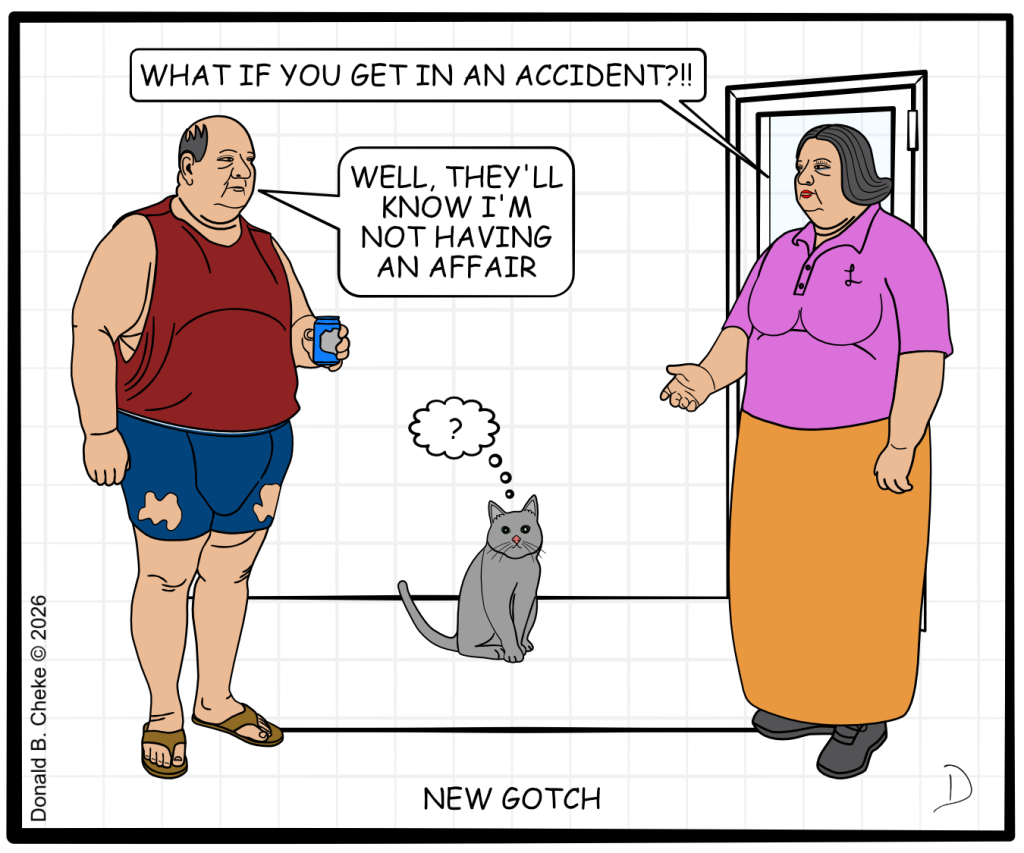
New Gotch – Created by Don Cheke
In response, and not having to give it much thought, I said, “well, they’d probably think that this guy’s certainly not cheating on his wife.” Why, you ask!? Because there is an old tale that states that you can always tell when a man is having an affair, if all of a sudden, he’s got all new underwear, or gotch, as we call it here in the Canadian prairies.
I should mention that this comment from Denise about me buying new gotch is a very rare thing. She is not the kind of wife that has ever policed my eating habits, my hobbies, or the clothes I wear. She has never made me a honey-do-list or anything like it. She has been nothing but supportive all the years we have been together. I suspect there would be many men out there that would be jealous of this if they knew. 👍😊
In a previous blog post, I had mentioned that I was starting to feel like it was time to upsize my shirts. Although the ones I wear look fine, according to Denise, I feel like they are tighter than I like – I prefer a loose fit.
After I ordered the new shirts today, one size up, I thought of the cartoon below. I grabbed the supersized bit when I thought about that whole supersize business with McDonald’s a few years ago. Loaf’s thought, as a response, comes from remembering his course at Insult School. He is finding that this a great response for many things and has learned that it works best as a thought and not vocalized where it stirs up too much trouble.
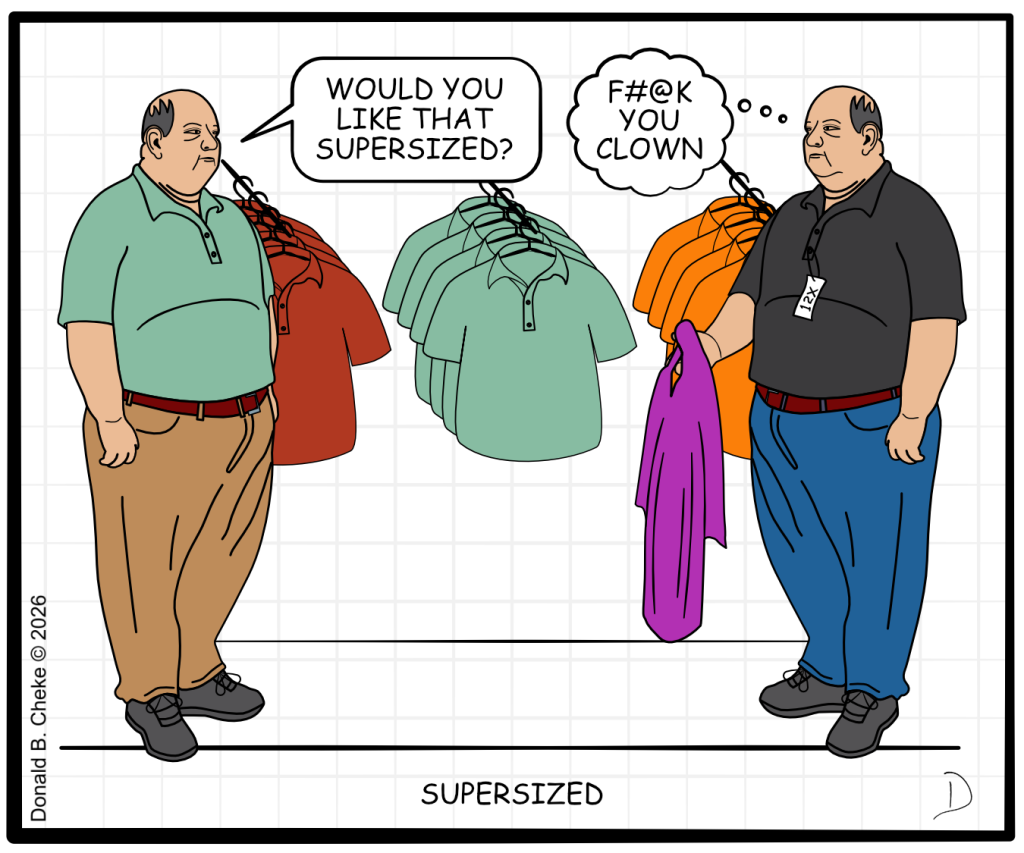
Supersized – Created by Don Cheke
Feature Image
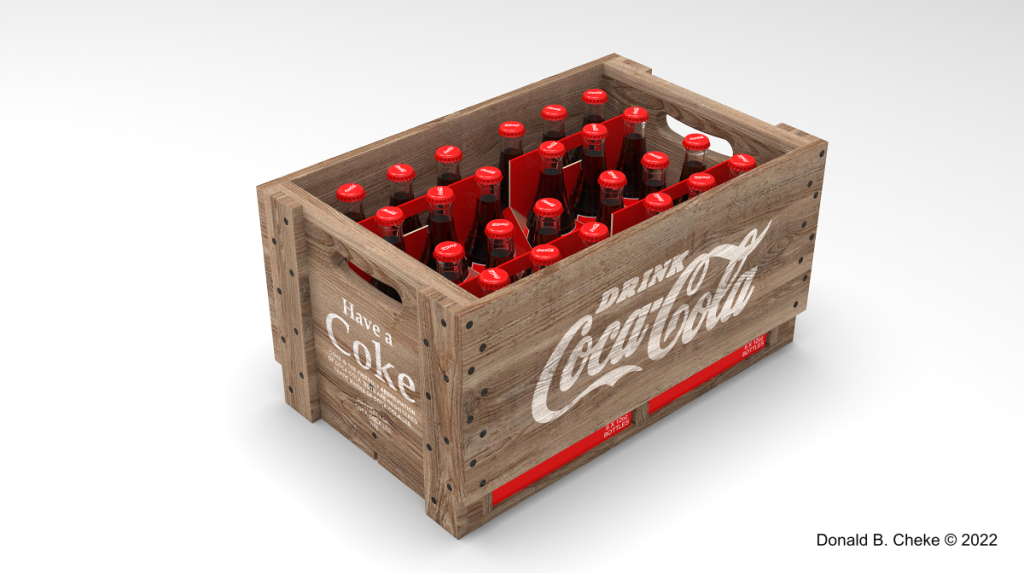
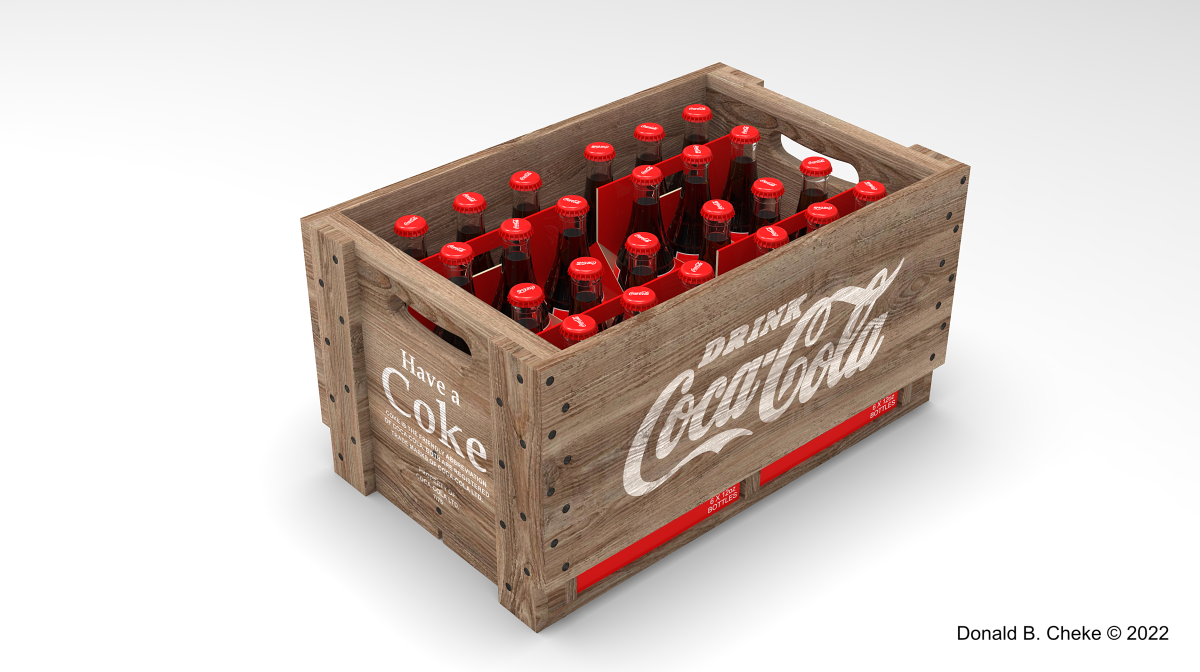
Coca-Cola 4 x 6 Full Crate – Modeled & Rendered by Don Cheke
In a blog post not long ago, I talked about a vintage filling station and how the only thing missing was a deck for old men to sit around sipping Coke and shooting the breeze. With this in mind, I chose to feature a Coke crate I 3D modeled and rendered in 2022. This vintage look sure brings back a lot of great memories for me. I modeled the Coke product because of its status as an iconic design, but I prefer Pepsi – have for as far back as I can remember.
Below is a second vintage piece featuring Coca-Cola. I just love the design of this vending machine and 3D modeled and rendered it in 2019 when I was celebrating vintage design.
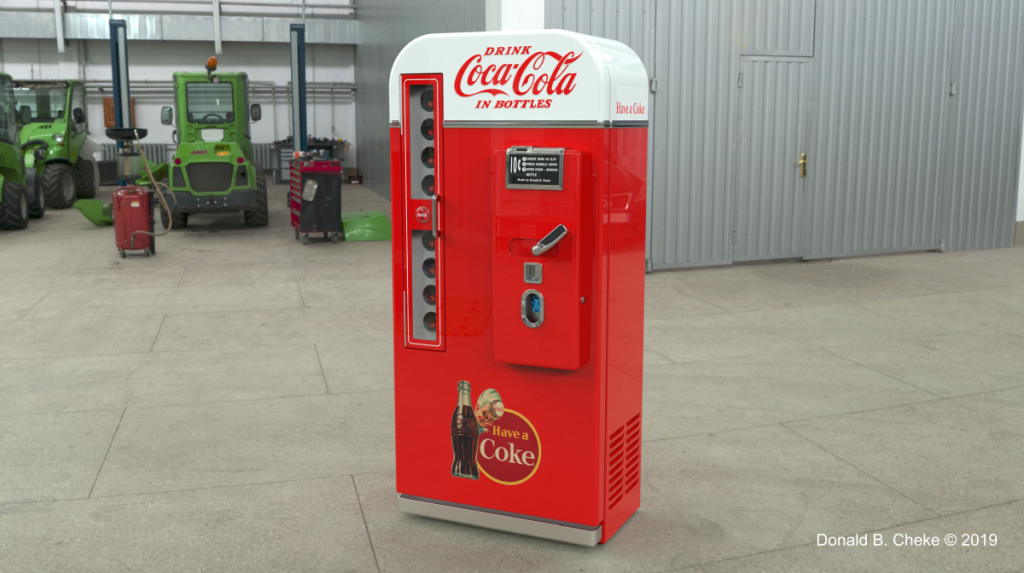
Vintage Coca-Cola Vending Machine – Modeled & Rendered by Don Cheke
Reading this, you must have made it through the whole blog post. Congratulations! I hope that you found it interesting and that it sparked some thoughts about your own journey. Share them in the comments if desired.
Donald B. Cheke – Saskatoon, SK
insult school. I remember it well. Had to learn to use my inside voice for safety reasons.
Thank you for sharing brother.
You are welcome, brother!
Another great Blog to read and thank you for sharing it all. I can sometimes relate to the noise discussion, especially when the 3 grandsons come aver and rough house in the family room without any consideration for all the other adults in the house. Usually it is only me that gets bothered by this. I think it is because I never had any of my own kids to get used to any of this so this is certainly a new thing for me I need to deal with.
Thanks Mike, for taking time to read the blog post and for sharing your experience.
Hey Don, great blog post!
I sure can relate to the noise of the world and the rage I sometimes feel. I often ask in those loud moments ‘IS THERE NO PEACE IN THE WORLD?’ OR, SHHHHH, SIMMER DOWN NOW EVERYBODY’!
I really enjoyed the ladder you mentioned as a tool to gauge what things one can expose themselves to. I have a long history and fear of flying, but in order to see the world I have had to work through that fear. With lots of exposure to flying, EMDR tapping and deep breathing I actually really enjoy flying now! The great realization for me is that changing my thinking, with the aid of a toolbox, has changed my experiences. So, hang in there!
Currently I am working at being a solo performer and this is an incredible challenge. I can sing with my group but the minute I’m solo, there is a panic that takes me out of my body. This anxiety is in part due to the ‘hyper vigilance’ I had to live with growing up in a challenging environment. Thankfully I now recognize I am a full adult and can have absolute agency over my thoughts and how they affect me. I just have to remember this when my parasympathetic nervous system starts to run away, much like you did when you decided to not react with the hallway wind! That is progress!
Thank you for the cartoon and the laugh out loud moments! I do enjoy Loaf very much!
Thanks Doug, for taking time to read the blog post and to share your experiences. I can only imagine the stress that the solo must bring. I am proud of you for following your dream!
….one correction, it is my sympathetic nervous system taking over. The goal is to be in the nice peaceful balanced one, the parasympathetic.