

Today’s art was inspired by someone I saw on Instagram when I participated on that platform. Although I have been away from there for a long time now, I still remember the artistic sculptures of Jack Eagan. I won’t show his work here, but please feel free to check out his art on his website (jackeagan.com) and many other art media platforms like Pinterest. For ease, I asked CoPilot to provide a brief summary of his work – “Jack Eagan’s sculptures are handcrafted bronze works that blend abstract organic minimalism with inspiration drawn from natural rock and stone formations. His pieces reflect a deep reverence for tradition and material integrity, often finished with distinctive colored patinas developed through decades of experimentation. Each sculpture is designed to evoke a sense of timelessness and transformation, engaging both interior and exterior spaces with quiet power.”
I must confess that I am quite envious of Jack’s ability (artistically and financially) and his access to the facilities that allow him to bring his art to the world. After I reviewed his art and felt inspired, I had a dream that night that I won a huge lottery. In the dream I was planning to purchase an acreage and build an art gallery and several workspaces on it. I would then create an art foundation where art students could attend and learn the many processes involved in all manner of art, including sculpture and foundry work. I planned on inviting artists to attend for periods of time to teach their art form and share their experience. We’d have a café for visitors to stop by and grab a bite, and we would plan many barbeques, where students and visiting artists could have a break and could share comradery. And, of course, we would create art to our heart’s content. It was a nice dream!
As I reviewed Jack’s art once again, I decided that I would try and 3D model and render some pieces that would mimic his work – and then create a few more pieces in the same style as his, but with my own artistic flair. I also decided that I would use the eroded look as my theme, something Jack does quite often. For those interested in the technical aspects, I used TurboCAD or SolidWorks to create the models, I used KeyShot to render the models, and I used my Rebelle painting program to add backgrounds and other details.
This series began without a map, so to speak. Each piece emerged from experimentation. How they would “read” would be a surprise once complete. As I worked on each piece, I knew above all else, that the concept of erosion would evolve. Only later, as I progressed, did I realize that my exploration of erosion would not be defined as destructive, but as transformation and survival.

Eroded Disc – Created by Don Cheke
Eroded Disc is based on the Discus of Olympic fame, although I left out the center. As most of my readers know, I am not a fan of competitive sports, but I do find the original Greek history behind these things quite interesting. Those early Greeks sure had lots to say, in all manner of forums!
My render program, KeyShot, has the capability to actually displace the 3D mesh of the model. It does so based on black and white masking images that users, such as me, create in other programs like Photoshop or Affinity Photo. Just so you get a better idea, the two images below are the ones I created and used for the disc – just for the displacement of the otherwise flat faces.
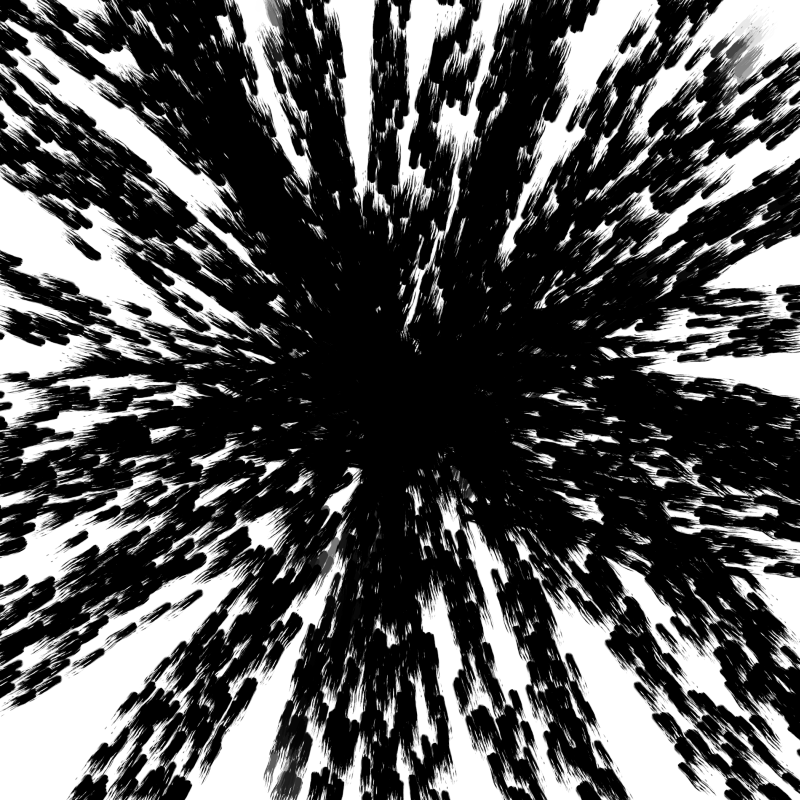
Radial Rough 1 – Created by Don Cheke
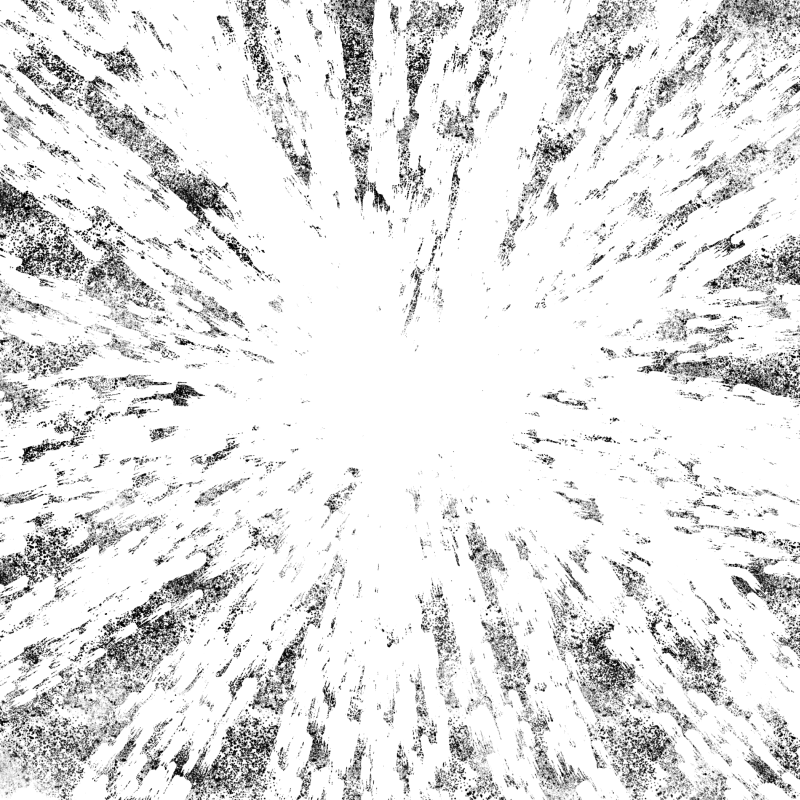
Radial Rough 1a – Created by Don Cheke
As we work our way through each piece, keep in mind that each sculpture/structure carries the marks of time – cracks, corrosion, wear. Even so, they remain intact. They have changed, yes, but are still whole. In these instances, the erosion is not violent, it is revealing. The erosion exposes new layers, new histories, and even new identities beneath the surface.
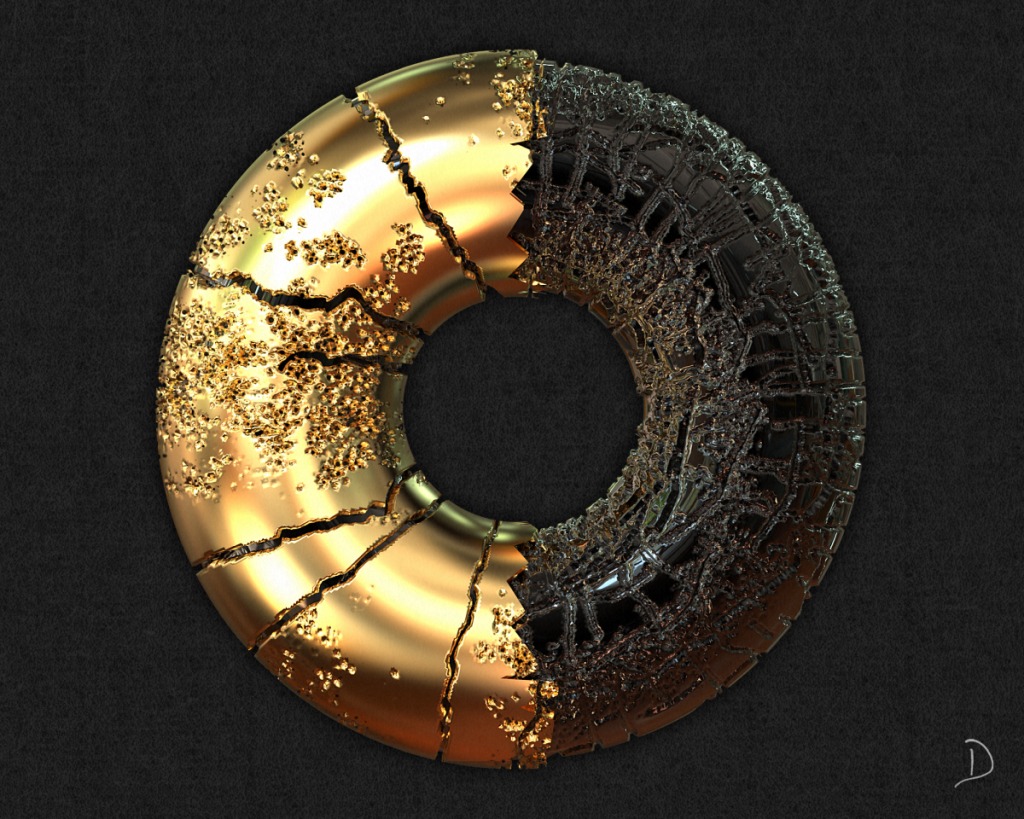
Eroded Torus – Created by Don Cheke
Eroded Torus is very much my favorite piece by Jack Eagan. I tried to mimic his as best as I could, but it is nowhere near as wonderful as his piece is. This piece has a bit of a dual nature – an inner core that exudes a hard-worked solid core – and an outer shell that, although cracked and broken, exudes a shiny brilliance. Like all long-lasting things, the progression of time, and the difficulties encountered, take their toll. This is the same for humans – we survive, we lose some of our luster but continue on with a beautiful patina of wisdom.
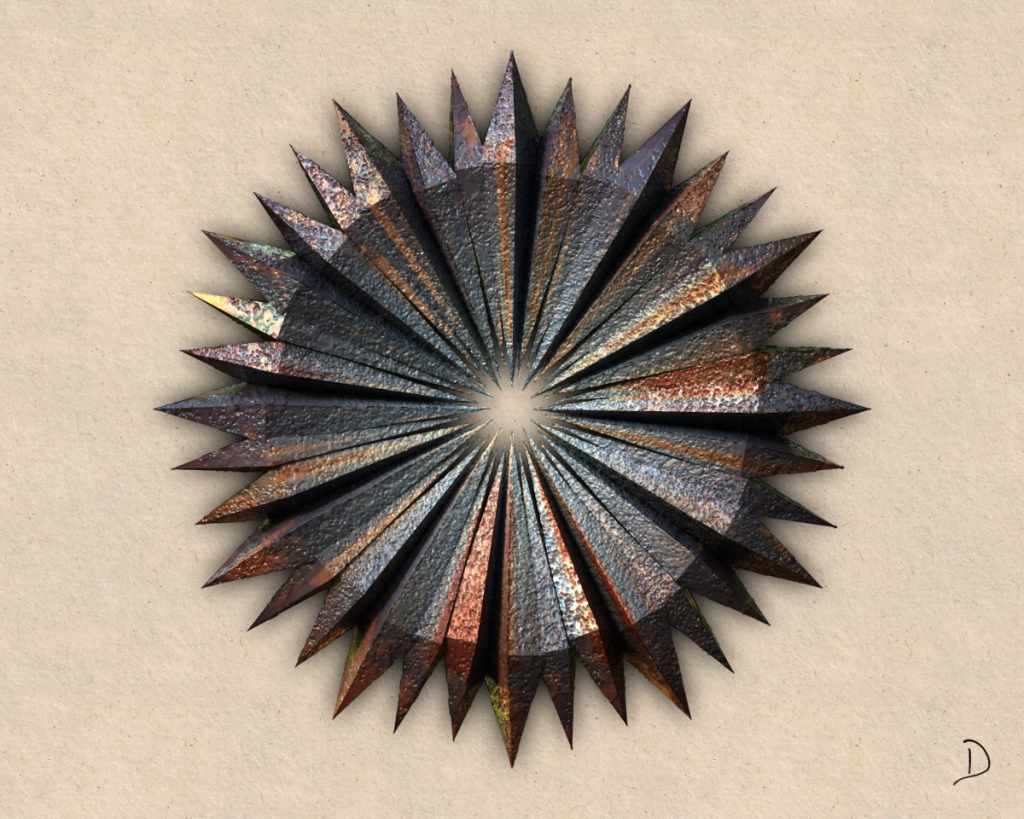
Eroded Points – Created by Don Cheke
Eroded Points seems a dramatic transition from the realm of artifact to something more mechanical. It feels more forged than sculpted – but still has a pitted patina indicating age and survival. This piece was not meant to disrupt the flow of the sculptural presentation, but yet it does move the series in a slightly different direction as we will see moving forward.
Below I show two eroded blocks images with different color schemes. I had difficulty deciding which one I like best, so I decided to show them both. Eroded Blocks and Eroded Jade Blocks consist of 18 flat panels with a simple carved motif on the face. They are angled and radial copied to create a ceremonial seal or medallion from an ancient forgotten civilization. In both cases, the blocks are pitted, while continuing to be reflective – even in the dips and dents – almost like they have been “updated” with a fresh coat of paint. As before, the damage symbolizes the transition of time. The fresh paint symbolizes renewal.
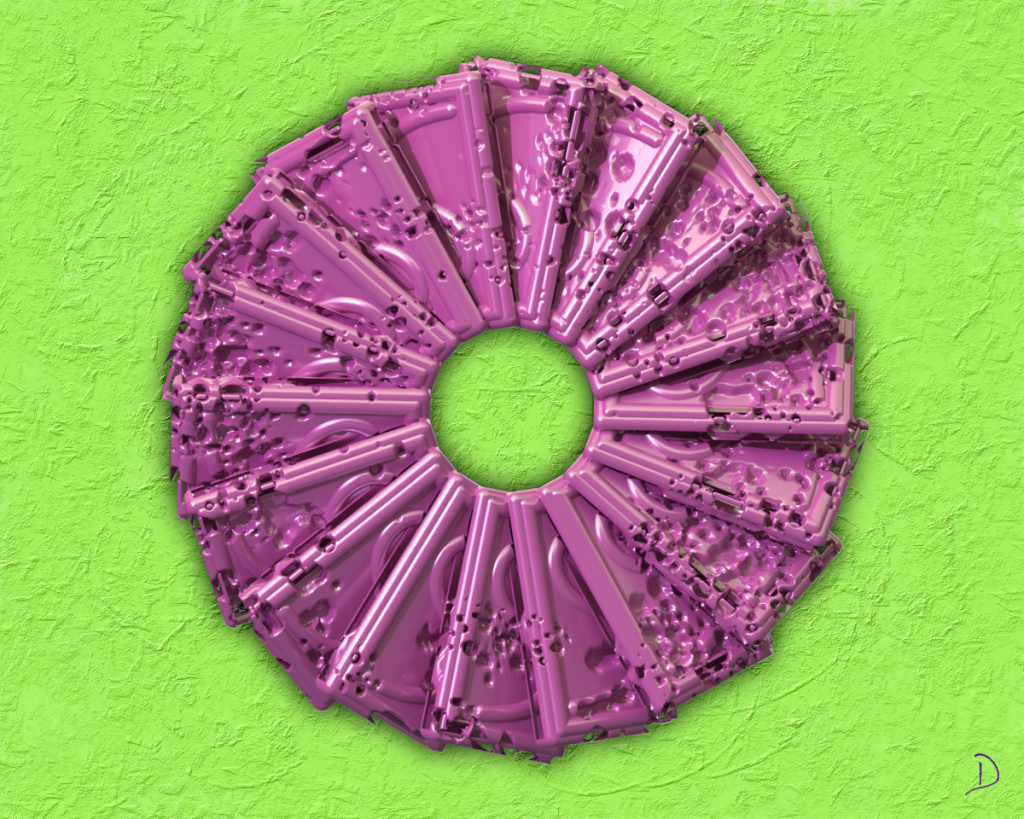
Eroded Blocks – Created by Don Cheke
The high-contrast purple on green seems to me to be more playful and vibrant. It almost feels futuristic and synthetic.
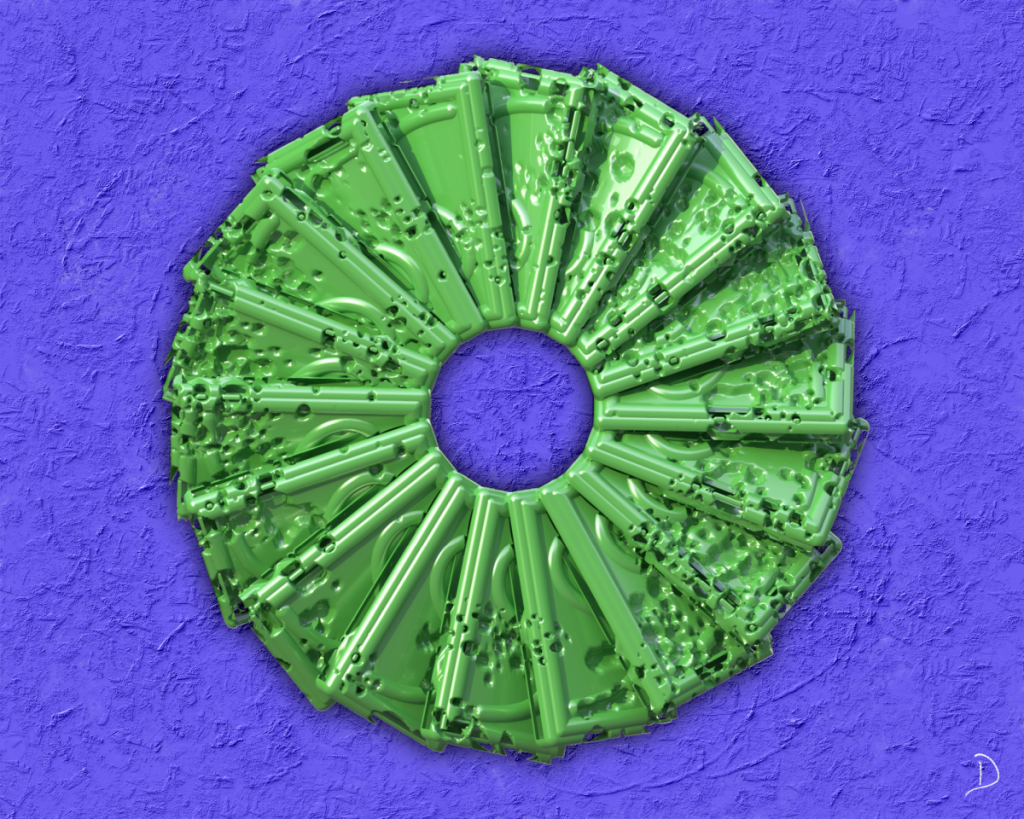
Eroded Jade Blocks – Created by Don Cheke
The jade on purple, on the other hand, has that lost civilization artifact vibe. It feels more sacred, more meditative – evoking a spiritual antiquity. When asked, my wife, Denise, indicated that she liked the jade version better. I didn’t try, but I bet the jade version would look great without the damage – a highly sought medallion for an Aztec king – or Tlatoani, meaning “Speaker”.
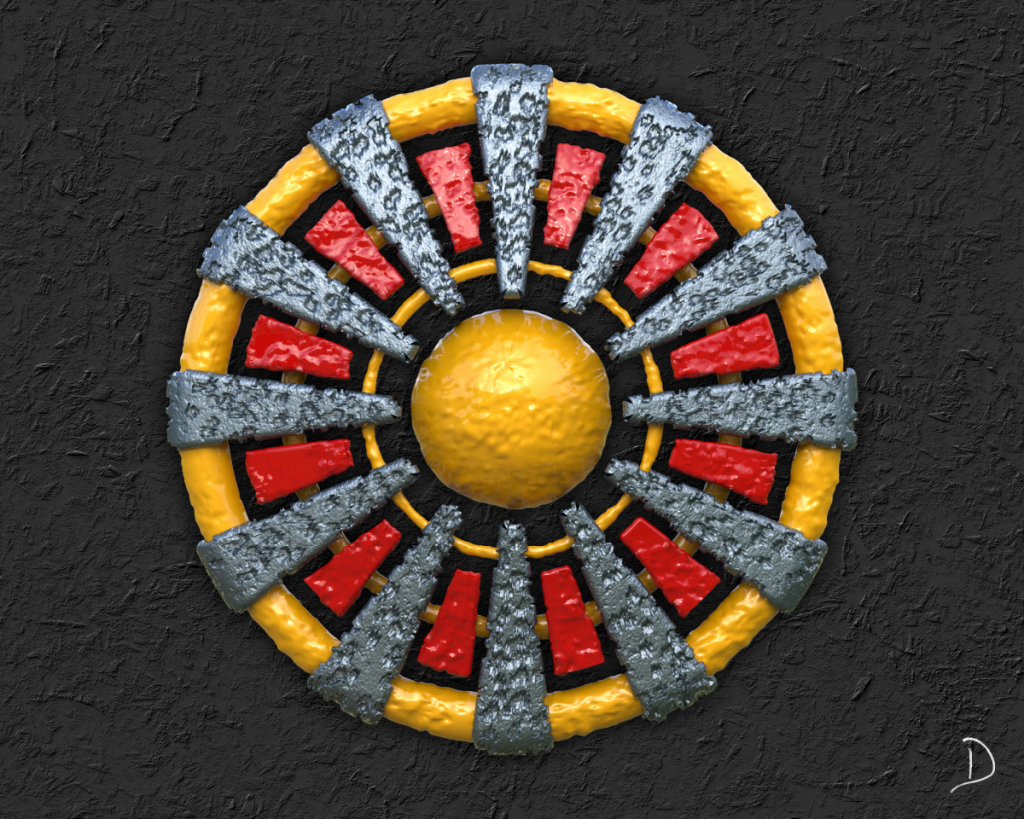
Eroded Sun Disc – Created by Don Cheke
The Eroded Sun Disc was a step outside how the series began looks-wise, but as I worked on it, it grew on me, as that saying goes. Like the one before, the Eroded Sun Disc has a kind of ceremonial seal vibe that ties together the themes of erosion – the commonality between all the pieces so far. This piece could represent a forgotten order, a mythic technology, or even a status symbol worn by ancients in a vibrant society who have earned a place in their community as an elder or shaman of sorts. Although brilliant, the symbol would have been small to keep with the humility that would have come by being that elder or shaman, whereas the jade medallion above would have been large, showing the wealth attained by the one wearing it.
Lately, I’ve had an urge to attempt sculpting something. I wanted something that would allow the tactile experience that digital art does not provide. Long ago, I tried my hand at clay sculpture. It was a huge mess, but I think that had I stayed with it I might have enjoyed it long-term. It was at a time when we were raising Emma, and my work world was always taking up so much time. Later in life I tried wood carving but didn’t pursue it very far.
So, all these years later I decided to try my hand at air-dry clay, something I have seen my granddaughters do with much success. Because of the pieces in this blog post, I thought it would be a great opportunity to sculpt something in that realm, hence the discus seen below.
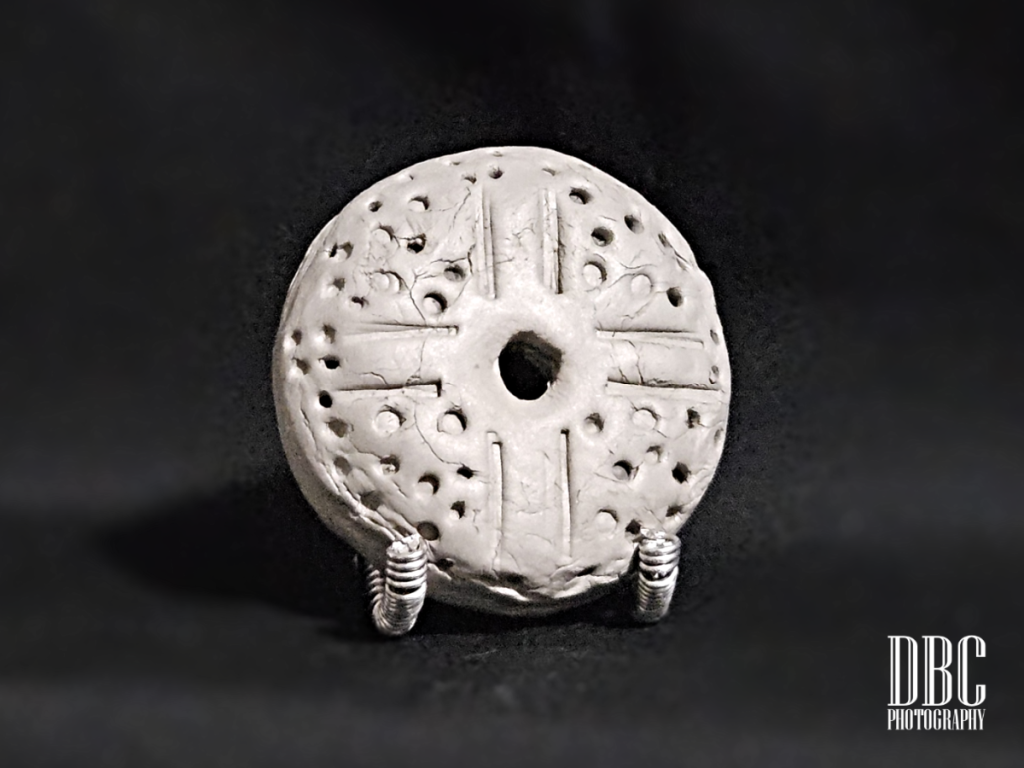
Eroded Medicine Wheel – Air-Dry Clay – Created & Photographed by Don Cheke
As you can see, I tried to keep with the eroded look, at least a little, while giving it an ancient civilization kind of vibe – a stone medicine wheel in this case. Air-dry clay is new to me, never tried before this piece. Because I didn’t know how well a thick piece would dry, I decided to first 3D model and 3D print an inner disc, which I later covered with clay – a sort of armature common in sculpture. As you can see, I broke out my old aluminum wire and created a stand for the disc. I hope that you like the result.
With the piece now finished, I must say that I found that the experience didn’t stack up with my hopes. The intended shape was hard to achieve and ended up looking more like a donut. When it comes to things like this, I guess I am still geared toward precision which is harder to attain in the hand-made arena. Perhaps if I had a shop, I would have approached the whole piece differently – like making the disc with a lathe and distressing it with other tools. In lieu of that, I decided to make a 3D render of how I wanted my air-dry clay model to look. Sadly, I can “feel” it, but I can’t touch it.
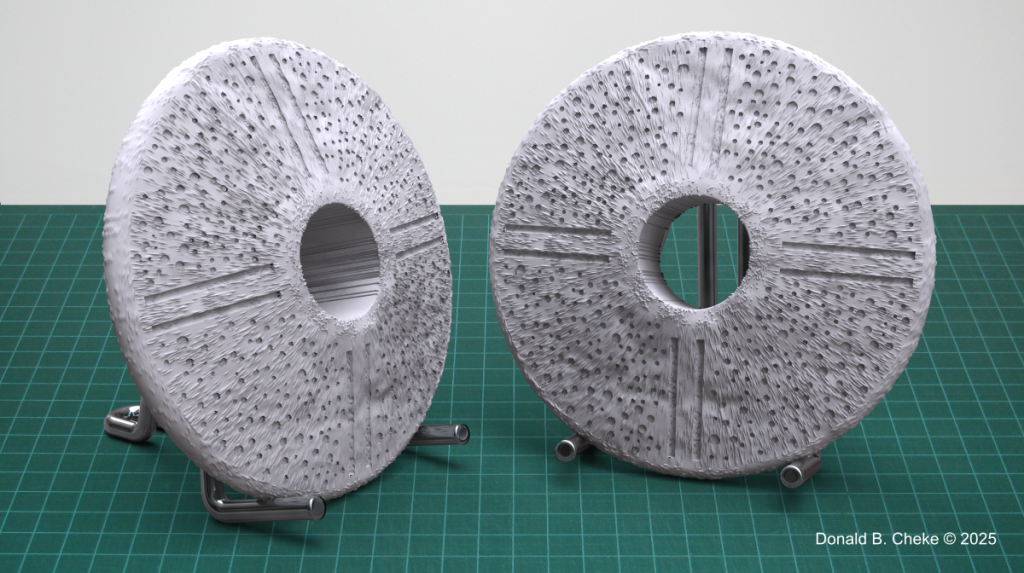
Eroded Medicine Wheels – Modeled and Rendered by Don Cheke
To sum up, these sculptures, being analogous to the human condition, and the process itself, mean that life is meant to be transformative, rather than destructive. We survive the changes that time brings over time – and there is a beauty in that. As indicated in the sculptures, no matter what changes come, something of the original remains, while the patina of time and change exposes new or different looks. And like the process of creating these pieces with no concrete path laid out, we humans have no idea where we are headed when we set out on the journey – and yet we land years later in a state that was unimagined at the start but hopefully has resulted in a beauty all its own. Rugged maybe, weathered even – perhaps missing and broken pieces many – but a place and life worth living.
Donald B. Cheke – September 15, 2025
Excellent art as usual. Eroded Torus is my favorite.
Thanks, Mike, for having a look and taking time to comment!
Thank you, Don. It’s a great read and really shows how much work goes into making art. It’s obvious that making digital art takes a lot of effort, especially when you want to give it proper meaning and feeling. Sculpture is another world, and I don’t know much about it, but some look very impressive.
I enjoyed reading about your dream. It would be wonderful if it came true. It reminded me of Tracey Emin, the British artist, who renovated an old historic building in Margate into studios and a gallery for other artists back in 2021. She wanted to do something special for her hometown. Now, ‘TKE Studios’ helps artists and people who love art, giving them places to work, learn and show their art. It’s a great thing for Margate.
Art has no limits, and that’s the best thing about it. Thank you for sharing your way of making art and for showing your work.
Thanks Suhail, for taking time to read the blog post and to comment.
Thanks for mentioning Tracey Emin and the foundation. I had a look at her website and the program and could see that as something I would have loved to have done – as the provider. When I looked her up specifically, I noted that she was the artist that produced “The Empty Bed.” I didn’t make the connection right away when you mentioned her here. 👍