
The miles continue to pass as we sail along Route 66 with stops, again, at the next Online Therapy Unit center. Further along we will take time and stop at the next vintage point of interest.
April 5, 2026
On this day, I wrote a response to the Week 3 message I received from my OTU therapist. She had asked some great questions about how I deal with the need for approval, and I shared with her my thoughts on the subject, and how this great need developed – that included some family history, and what I have learned on my journey of recovery. She also asked about the intricacies of my winter depression. Again, I laid it out in detail and enjoyed reviewing my inner workings while writing about it.
Also on this day, I dug into the additional OTU resource called Cultural and Emotional Wellbeing. I was curious as to its contents as it wasn’t that long ago that I wrote the blog posts on Cultural Art and The Harvest. Much of what resonated with me in the lesson was what I presented in the blog post, plus a whole lot more. I had lots to say, and again, I left mt therapist lots to read in a message.
April 6, 2026 – April 7, 2026
I spent these days reviewing Lesson 3 of the OTU course. I have lots to say about that, so brace yourself. Because this was going to be a lengthy part, I decided to spare you most of what I did and learned on April 5th.
Below are my thoughts while working through the Lesson 3 presentation – About Physical Symptoms experienced with depression and anxiety.
Before getting into lesson 3, I thought about what my physical symptoms are, when depressed. Sleepy for sure. A hollow feeling that needs filling – often filled with eating. For a laugh – I eat when I’m sad, I eat when I’m happy, I eat when I’m angry, I eat when out with friends, I eat when celebrating, I eat to pass the time, and I eat when I am watching TV. Oh! – And eat when I’m hungry! 👍😊
I’m not typically an anxious person, so I don’t feel pangs of panic or dread, or even fear. I did years ago before recovery, but I am far removed from that now, and have been for years. I am, as indicated above, more prone to feeling down and self-hate, than I am to anxiety.
I can usually identify why I am having issues when I use a tool I learned in Al-Anon called HALT. Am I Hungry, Angry, Lonely, or Tired? Noting one or more symptoms provides an opportunity to address the issue, without blaming it on some outside source or getting too mired down by it. I almost always relate to three of them – Hungry and Angry – usually one bringing on the other, and Tired, often felt on its own, usually leading to Angry if left too long – certainly causing me to have a shorter fuse or feeling less open and compassionate to others. Denise and I learned long ago that after 7PM we are both tired, and it is best to spend time on our own to lessen the possibility of locking horns. I go to my room and watch TV, and she goes to her room to talk on the phone (Emma & my mother), to take her nightly pills, and to read in bed. Occasionally if one or the other, or both of us are experiencing HALT during the day, we joke and say that maybe we should set the time for moving apart from 7PM to noon. That makes us laugh and we take steps to find out what’s going on and what we need to do to get through it. It works well for us. That is not to say that we are not there for each other if the need arises, which it does from time to time, even after 7:00PM.
On with the OTU lesson….
The cycle of physical symptoms, unhelpful thoughts, and unhelpful behaviors is something I can identify with. There are many different cycles I have seen through my years of recovery. There are those that look at parenting, at living with the isms of alcoholism, those of mental health, and so many more. Breaking the cycle is the key to recovery in all these cases – at least I think so.
I like how the OTU material looks at depression as under-arousal and anxiety as over-arousal.
Overcoming depression and anxiety, in my mind, requires taking active steps to break the cycle. That doesn’t ignore that the symptoms might require medical intervention, if they have traveled far enough to warrant medication. Thank goodness that the stigma of taking medication has lessened significantly over the years. I know many people who take medication to get their bodies/brains back on track. The mind/body connection has never been lost on me. I like how the OTU material looks at Activity Scheduling and Controlled Breathing as ways to lessen or eliminate symptoms – at least for periods of time – or longer if one gets into the habit of taking care of oneself. Self-Care as we hear in mainstream society.
Although I agree with the OTU statement, “The good news is that you can learn to manage these physical symptoms by doing the opposite of those symptoms.” I know from experience how hard it is to do that. I guess the key is to fake it until you make it, as I have heard in the past. It is like when one loses their job and is grieving the loss. Perhaps one feels angry at the loss and the last thing they want to do is look for work, or face interviews. Here they are, having to put on a positive air at a time when they feel least like it – angry, depressed, beaten down. Being able to fake it for a while ultimately finds one with a new job, and they can then get past the depression or anxiety they were feeling. It’s certainly hard work, but it’s better than the option of wallowing in depression and sinking further due to lack of motivation and effort. I have seen this in others, and only in myself once or twice. I usually fixed my job loss problems by starting a new business, thus bypassing the fear and anxiety of looking to others for work. I guess that is action too!
I have certainly seen my own under-arousal, or depression, work its destruction, or take its toll, especially in the winter. Winter just zaps me and I can easily sleep much more than usual. Sometimes I have stayed in bed in the morning because I just didn’t see the point in getting up. Very often, I have been able to force myself up and just start something – and then I find my motivation kicks in and off I go. I have seen, so often, that I just need to get started on something, be it writing, creating art, or just going out for coffee, will change my whole outlook in short order.
I loved how the OTU lesson talked about the downward spiral of under-arousal. To me that is what I consider a self-fulfilling prophesy. Doing less makes one feel like doing less – and down it spirals until a bottom is hit, and it becomes “do something or die,” or it is doing something before hitting that bottom. I know from personal experience that I needed to hit an ugly bottom when it became obvious that I couldn’t continue doing what I had been doing. My bottom came when I was 22 years old. I had quit my job, I was drinking far too much and starting to have car accidents here and there – a curb here, a parked car there, a fence, and so forth. I tried running away one night after a night of drinking and would have died that night had a truck-driver not found me in a snow filled ditch many miles away from the city. I was heading to Texas, where I thought I would find a new life. Obviously, that did not happen! Not long after that, I was stopped by the police and charged with impaired driving. I vowed that night that I would not turn out like my father and I quit drinking. Luckily, when I had quit my job, I was approached by a friend who said that her sister and brother-in-law owned and operated a dairy farm 40 minutes outside Saskatoon had work if I was interested. I decided that I would take the job. After losing my license I was afraid that they would no longer want me, but again, my luck held and off to the farm I went. The loss of my license was a godsend since it would keep me from traipsing back and forth to the city and keeping up with my old ways. I began my recovery caring for the cows and came a long way. When I returned to the city a year and a half later, I had a couple of very small slips with old friends and alcohol but when I found my way to AA, which was not what I needed, I found my way to Al-Anon. I never felt so much like coming home walking in those doors – like the prodigal son coming home. I eventually met Denise there and my old patterns evaporated completely and a new life in recovery and love took root. We made new friends in the program and maintained friendships with only healthy people from the past, like my friend Mike who came through life with me – through thick and thin, I might add.
I knew that lesson 3 was going to mention physical activity, and I thought, here we go! I have never been a physically active person except for in my early work world where being physical was part of the job. That said, I know the power of being active, but I have always found a gentle walk to be what I enjoy. I can’t walk as far as I used to but I know that when I do go out for a walk or walk in the halls in the winter, I feel better for it. On a more humorous note, when Denise said that her cardiologist asked if she could walk a kilometer or two, I said, “Did you ask him if that was in a week or a month.” 👍😊 That’s how I would answer, for sure!
I have great difficulty maintaining even the activity of walking. I know that I suffer because of that, but there always seems to be a reason to keep from doing it. During my more active seasons like spring and summer, I do better some years more than others, and I am even okay taking time to rest on the numerous benches in our park – at least I am out, instead of crouched at the computer day and night. But – I am a hard nut to crack.
The OTU material suggests one schedule activities, things one likes to do. I get the power of that, but I am more prone to spontaneity, just ask my wife.
One of the things I find in these discussions about being active is that as I get older, and especially for my wife, is that our chronic health conditions make it much more difficult to be physically active. I simply can’t walk like I used to be able to. Gosh, Denise can barely keep upright because of her Parkinson’s disease. My weight makes it hard for me, and I just don’t have in me what it takes to lose weight. One year, long ago now, I spent a whole year, no matter the weather, walking outside for one hour each day. I also monitored my eating, so much so, that it became my life. I hated how food became the sole focus of life – that monitoring BS. I lost 96 pounds, but I hated every minute of it, and it never became a habit. Sure, there were moments during the summer of that year where I might go for long bike rides and find much joy in that. Still, after that year, some minor crisis happened that made me lose a day here and there, and then one led to two, and two led to seven, and on and on it went, until I walked very little. Over the years I gained all the weight back, and then some. During that year of walking and weight loss, I attended a weight loss clinic. One day while being chastised for eating a couple of cookies, the clinician shamed me endlessly and ensured that I understood that if I gained the weight back, I would never lose it again. I hated her for that, as it rattled around in my brain for years. Maybe it was true, since I am huge and have never been thinner again, but more so, I think she set it up as a self-fulfilling prophecy. In my more positive states, I remind myself that I am loveable, no matter what my weight is, and that I can still choose to take some steps to regain some kind of fitness, even if it is just a short walk in the park – when I can manage it. I don’t use things like others do – step counters and timers, so I am not judging myself. I hate to be judged! My journey is my journey, and I expect people to mind their own business. In my case, I am lucky that my family takes me as I am, and I never feel judged by them – just as I never judge them.
Moving on to the next part in Lesson 3, over-arousal, and before reading what is there, I can say that I don’t react so much with anxiety, not like before recovery. I do feel stress occasionally, like most people must, but I don’t think it is off the scale one might consider normal, normal being a poor word to use, but seems applicable here. This next bit, I am not saying, is the same for everyone, but I remember in my very early recovery when I grew a beard to physically hide. I was fresh back in the city and didn’t want people from the past to “see” me, and I was still raw with regrets and shame for my past. I am still afraid, or at least hesitant, to run into people from the past because I am afraid to be judged for my weight. I would never go to a school reunion for that reason, but also because I hated those years and never wanted to remain in touch with any of them anyhow. Yes, I am shallow enough to think that I would go if I was thin, rich, and successful, just to show how well I turned out. LOL! I still wish that some of my former teachers would read my books to see how well I did and get that “atta-boy” that I think will make me feel better about myself – all the while knowing that I don’t need their approval or recognition. You get that right!?
I like how the lesson presented the condition or reflex of fight or flight in the over-arousal state. I am familiar with this concept and feel it is a good indicator that something is up, an indicator that can let one know that something needs to be evaluated sooner, rather than later. Is the danger real, or is it based on old fears and beliefs. I have mentioned before how I feel some stress while heading for groceries, thinking that the shelves might be empty. This now illogical feeling started when we had supply issues during COVID and for a while after. It has been years now since COVID, but I am aware how that feeling lives on. It is much shorter-lived these days, but I still experience it and need to talk myself through it. I’m not sure I would call that a fight or flight reflex, but it certainly is a fear reflex.
My life is lived on a very small scale, so I don’t encounter that many stressors, like one does when they still work out in the world, or ones that have current dysfunctional families such as those living with active alcoholics, or severe mental health issues. Without recovery, I am sure I would face much stress and fall back into many unhealthy patterns of behavior. I am so thankful for my recovery because I have the tools to deal with such things, but as stated, it is a whole lot easier not being smack dab in the middle of that sort of thing.
Good points were made in the lesson about the spiral upward with over-arousal. I get that, how one’s symptoms get worse and worse and adrenaline and out of control thoughts push things to the brink of explosion, or something like that – a full panic attack, or a physical lashing out. I can imagine the self-hate and guilt that would come after such an uncontrollable episode. I touched on this sort of thing in my message about managing anger. This, a reminder that I do experience anxiety from time to time. Interesting that I didn’t think I did at the start!
I find it interesting that the key tool mentioned in lesson 3 for dealing with over-arousal is controlled breathing, a good one for sure, but it made me wonder why it is not suggested for depression, or under-arousal. Perhaps it is because I think of controlled breathing as a form of meditation. I think that one suffering depression can, instead, meditate using breathing as an aid, to sit with themselves and empty their mind. Thus, allowing for some peace to result and possibly allow for an embrace from a warm and loving universe.
I can see how controlled breathing can be beneficial, as it helps one focus on something other than the issue(s) at hand – it pulls one back down to earth in a gentle manner. Because one’s mind can wander, even when meditating, the act of focusing on the breath allows one to lose the other thoughts to the gentle wind, metaphorically speaking. I like to mediate with headphones on while listening to music. I can easily get taken out of the world and into a calm state by doing so. I am not so keen on performing the 3/3/3 rule of controlled breathing (in for three seconds, hold for three seconds, and exhale for three seconds), but much prefer the slow rhythm of just in and out. I think it still provides something to flow with – a natural rhythm, a connection to mother nature, or the spirit, as I might call it. Perhaps, a calm blue ocean, as it can feel to me.
I can really see the benefit of selecting controlled breathing as a coping mechanism, it is an active way to put on the brakes before one loses it in a panic situation, or when anger starts to brew over something like traffic congestion while out driving – refocusing, reframing and being better for not having lost it, and regretting an unhelpful behavior, etc.
Overall, the lesson 3 presentation was very reassuring. I will now move on to the shared stories, the FAQ, and the DIY segments of this week’s lesson.
Also, on April 6th I decided that the ride I have with my Kia Sorento is near intolerable. It has never been the best ride, and if it weren’t for that, the vehicle would be perfect. Thinking that I might be able to change the suspension to something smoother, I stopped by a repair shop that I have used and trusted in the past. It was disappointing to learn that the only option was new OEM (original equipment manufacturer) replacement parts – meaning there is no options available like one might find for some other vehicles. The fellow at the shop said that due to the mileage on my vehicle, it might be time to make the change anyway and that might help with the ride. He suggested starting by changing out the front-end strut/shock/spring assemblies and doing the back if didn’t help a lot. He could not guarantee the ride would be better, and certainly not the ride I told him I was hoping for – that is something along the line a person might expect in a 1966 Cadillac Deville – the floating car, I think they called it. 👍😊 After some discussion with Denise, I booked a date for the swap out. It will take place on Thursday, the 9th. It will cost $1303.00. Dee says I am worth it, and if it helps, that will be wonderful. The old ones have 140,000 km on them. Surely there will be some improvement!
Feature Image
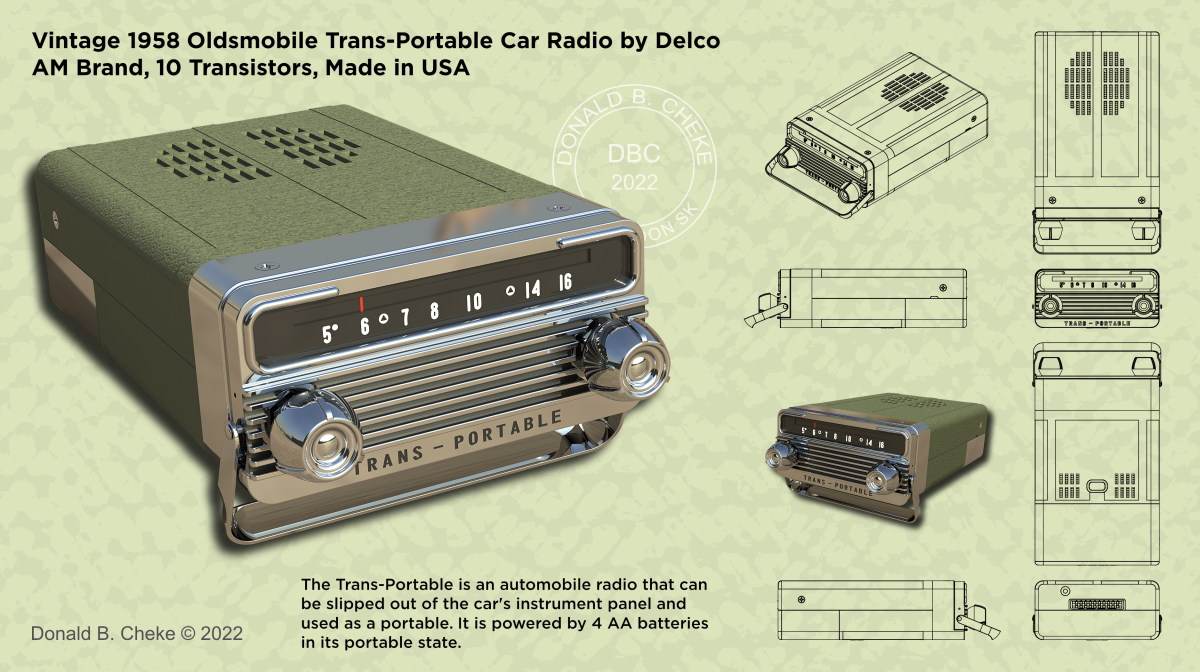
Trans-Portable Radio – Modeled & Rendered by Don Cheke
The trans-portable radio was something I stumbled upon in 2022 while looking for things to 3D model. I found a picture online within a brochure for the car/devise. I was so surprised to learn that as far back as 1958, there was a removable dash-mounted radio that owners could pop out and listen to while picnicking, or some other outside activity. The brochure was not as detailed as mine, but because I made a 3D model, I could show all the orthogonal views in line-drawing format, and some isometric views in rendered image format. Isn’t it one of the coolest things you have ever seen! I just love it!
Thanks for taking time to read the whole post, assuming you have. One would think that I would run out of words, but apparently, there seems an endless supply.
Here’s looking at you! Happy travels, along the road we call life!
Donald B. Cheke – Saskatoon, SK
Thank you for all your sharing and excellent writing!
Many of these reflections resound strongly within me!
As someone who leans towards anxiety I continue to unravel the origin of this (alcoholic home growing up) and how I can recognize the thoughts and behaviours connected to this in adult life and write a new script towards self-compassion and calm!
The flight and fight are VERY relevant to everyone and now I am learning about fawn and freeze and the role they played in my early life. All four of these I now refer to as my ‘survival wisdom quartet’ that kept me protected as a child! As an adult these do not serve me in the same way and I work to move through them differently!
Oh and big shout out to a smooth car ride! I hope it is corrected in your favour! You deserve it!
Doug C.
Thanks Doug, for taking time to read and comment on the blog post. I appreciate your vulnerability and hearing of your tools. I understand freeze, but I am not sure I understand fawn. Is that like fawning over someone to make them like/love you in the hope of making you feel worthy, or something like that?
The ride in the Sorento does seem better, even though the roads are so rough. The jolts don’t seen near as harsh, so that is good. The steering certainly feels stiffer, in a good way.