

In today’s blog post I am going to talk about the harvest – what that means to me, and so much more. As is usually the case, I will also present a number of recent art pieces I created and talk about how they came to be and what they mean to me.
Let me start by talking about the feature image. This will sound very strange, but this piece started as a photo of a small bathroom towel.
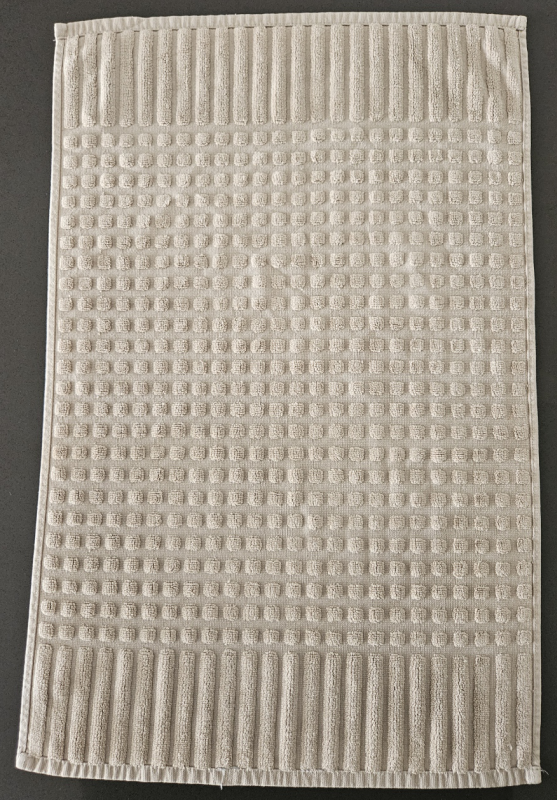
Towel – Photo by Don Cheke
I have always appreciated the design of this towel – often making me think of a high-rise building, maybe even one of the NY twin towers. Recently I decided that a photo of it might make for an interesting texture in a digital painting, and as you saw in the feature image, it did – well a portion of it anyway. I blended the towel image with an abstract digital painting I created as a background. As I looked at what came to be, I saw, what looked to me, a commercial farm orchard, where trees are planted in rows, leaving space between for maintenance vehicles and for transport vehicles at harvest time. To continue with that theme I added painted paths, which might indicate routes during harvest. To complete the idea, and the art piece, I added the word “harvest” in many of the world’s languages. My use was random and certainly not complete. According to CoPilot, “linguists estimate that there are approximately 7,000 languages spoken around the world today.” That’s a lot!
My wife, Denise, and I discussed the word harvest, or “the harvest” and its many meanings. Below are some of the thoughts that came out.
Of course, our first thought was the literal definition, which might read: The process or period of gathering mature crops from the fields. It might also be considered the yield itself – what was harvested.
Here in Saskatchewan harvest time is approaching fast. Saskatchewan is an agricultural province, so grain farming is significant. Travel the rural area and one is sure to encounter the many seasons of growing with planting, caring, maintaining, and harvesting. To me, all have their beauty, whether it is the human industry, so apparent in the activity of the workers, or the lush and colorful crops – the sheer expanse of it all – greens, yellows, purples, creams, and golds. There is so much beauty in Saskatchewan, no matter the season!
As a girl that grew up on a farm in Alberta, Denise sees herself connected to the land. When she thinks of harvest, she thinks about her relatives who have farmed the land for generations. Harvest time, she said, “is always an exciting time of year, especially if it’s been good weather and the potential to gather whatever you planted is bountiful. That, and getting your crops sold, ensuring you would survive another year.” Although she didn’t mention this during the discussion today, I remember how Denise has often talked about the busyness of farm life, especially her relative’s farm near Consort, AB, where she lived for a time. Whether seeding or harvesting, the family worked hard! She remembers fondly, how her Aunt Helen would load up lunch and supper for the crew and haul it out to them in a trailer, where they could break for sustenance and get back to work as soon as possible. The family worked well together, and the younger generation continues to do the same today. The younger generation – LOL! They are the same ages as Denise and I. 😊 It is hard to say what the future holds as there does not appear to be a next generation that is interested in carrying on the tradition. A common story, I would say.
Denise mentioned the pilgrims and how hard they worked to cultivate the unbroken land and survive with limited resources – tools included. Although we have many creature comforts these days, I still think we work just as hard in many ways – and the stress is just as real – all on a much grander scale.
As Denise and I continued our discussion, we agreed that there is a whole lot more to the concept of harvest. We believe it is a common word throughout the world that binds us as humans, each culture celebrating in their own way, but ultimately with the same things in mind, at least I think so.
We think this includes things like cause and effect, be it planting and harvesting in the sense above, or the more philosophical or religious sense of “you reap what you sow.” This, of course, can be looked at in all areas of life. How or what you teach your children. How you treat your neighbors. How you run your business. How you approach your own mental health. So much more….
Harvest also implies time and patience. It takes time to grow and cultivate fruit – fruit meaning the results of our efforts. Sometimes growth seems so slow and we lose patience, but one must remember that all good things take time. This is especially true for those more philosophical things where lessons are learned and we are resistant to change.
For many cultures, harvest is tied to the cycle of life – a time to live, and a time to die. The cutting down of crops is symbolic of that, as is the planting of seeds.
Most cultures have celebrations that focus on the harvest. We give thanks for the bountiful Earth; we give thanks for the people in our lives and the new ones that arrive and will continue the human legacy onward. The Jewish culture celebrates with three major harvest festivals – Peasch (Passover – spring), Shavuot (Weeks – late spring), and Sukkot (Tabernacles – autumn). They all have significant philosophical roots regarding freedom, revelation, and shelter. East Indians have many festivals throughout the year that vary by region. Check out Nabanna, Nuakhai, Makar Sankranti, Pongal, and Onam, as examples. Their common themes include gratitude to nature, community bonding, and seasonal markers. As a Canadian, we celebrate harvest on Thanksgiving Day with a mix of family, regional, and national traditions. Like the other cultures mentioned, Canadians are celebrating our bounty and our community bonding. We are honoring our agricultural heritage and celebrating our multiculture contributions. It’s a beautiful thing!
Of importance, Denise had this to say: “When thanksgiving time comes around, we give thanks for the harvest season, and we give thanks for what we’ve been provided for on a daily basis.” On a more philosophical note, she said, “harvest doesn’t just mean at the end of a season or at the end of a time period, or even at the end of a life. We can harvest each day. At the end of the day, we can look at what we did, what we learned – what we harvested from that day.” This is very reminiscent of the 10th step in Al-Anon, which reads, “Continued to take personal inventory and when we were wrong promptly admitted it.“ And, as I like to add, to celebrate the wins – the things we did better with the knowledge we have gained – the wisdom we have earned!
What do you think about when you ponder the concept of harvest, or the harvest, as I have called it here and there?
Let’s look at some of my recent art now. I wonder if we will see any connections to the harvest.
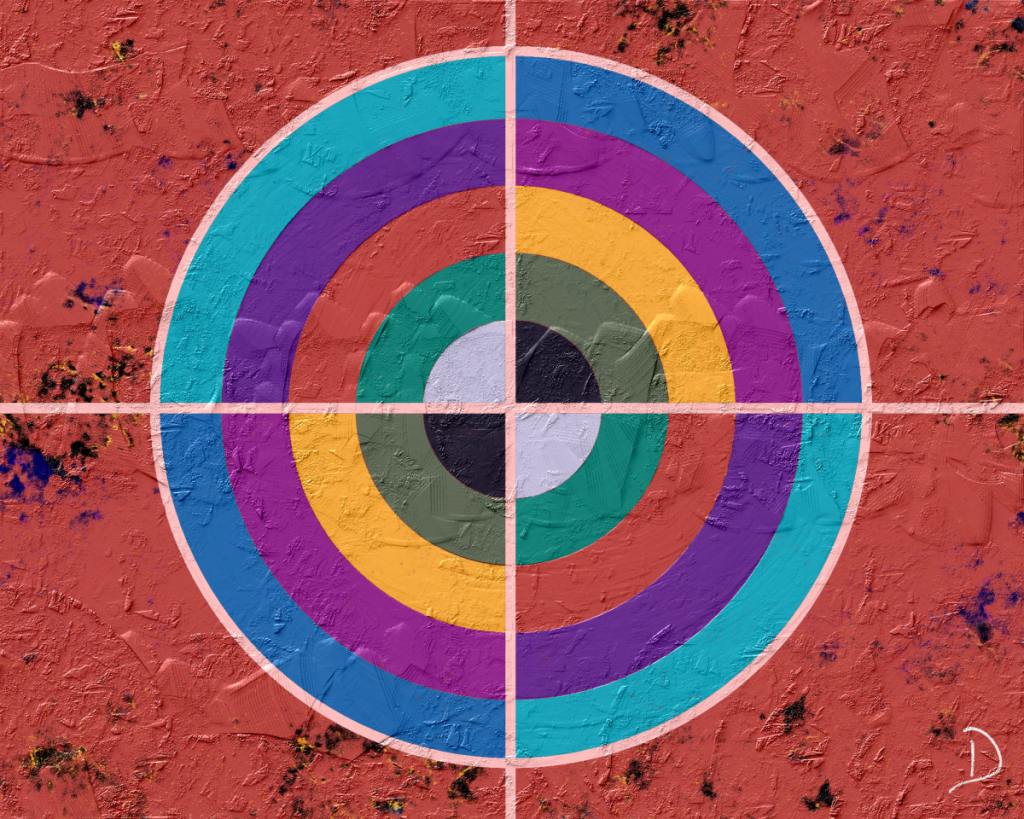
Quaternity – Created by Don Cheke
I created this piece while continuing my exploration into aboriginal art. At one point in my life many years ago, both Denise and I were invited to attend an annual local convention called Awasis (Cree, meaning “child”). My first-cousin Darryl, a schoolteacher at the time with a Metis family background, was one of the organizers. Because Denise was a teacher in the same school system and because he knew of my personal journey of growth, he thought we might find it interesting, so he offered a formal invitation. We attended two or three conferences over the years and found them fascinating. There were all kinds of workshops and both Denise and I participated. In one memorable session I volunteered to play a tribal drum while a guest speaker/entertainer played guitar and sang. It was a great time! In another memorable art workshop, we were asked to create a piece of art using ink and a piece of sting. Other mediums were available as well, but we were to start with the ink and string. After I dipped my string in the ink and moved it on the paper, I immediately saw something that looked like an abstract Indian head to me. I added abstract feathers with some pastel colors to mimic a headdress. In the upper corner I created a symbol – a native quaternity symbolizing the interconnectedness of the four cardinal directions, the four winds, the four seasons, and the four aspects of human existence: body, mind, heart, and spirit. It represents wholeness, balance, and the cyclical nature of life and the universe.
With that all in mind, I created the new abstract quaternity seem above. I tried adding additional elements to further define it, but Denise said that it didn’t need them, that people could easily read into it what they perceived. Denise always makes good calls when I ask her for input! Thinking about it now, I could have made all four quarters different, as opposed to having only two styles seen on the diagonals, but alas I did not think about that at the time.
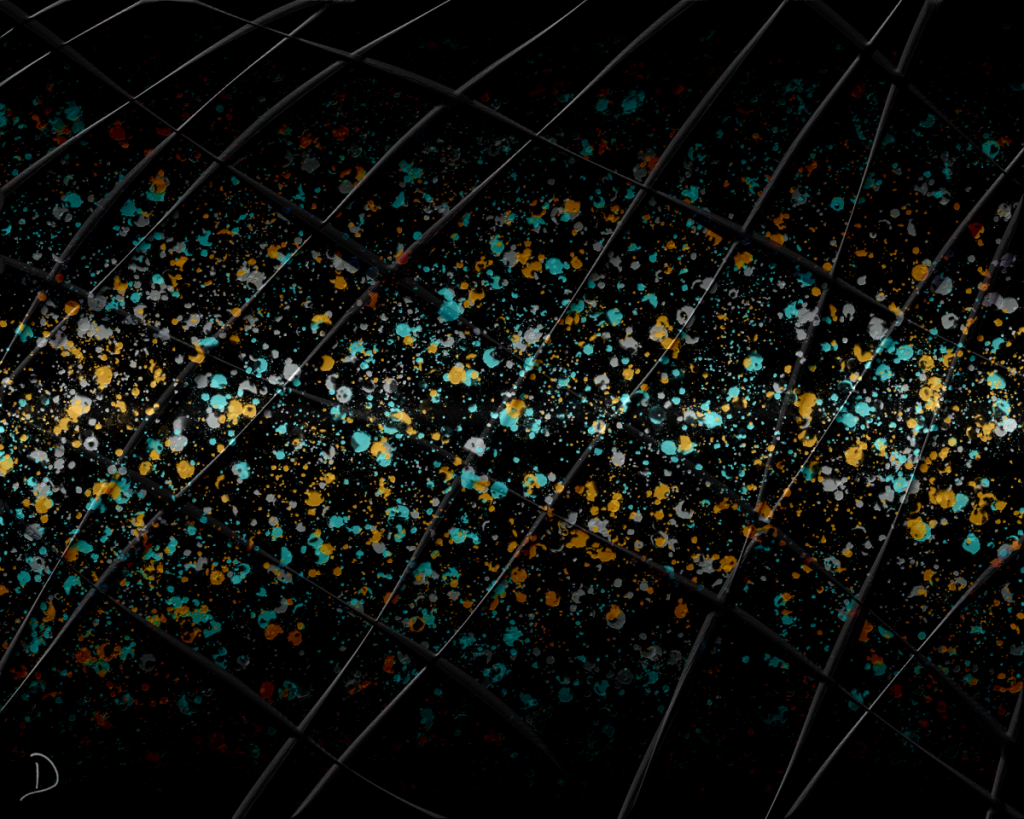
Abstract 080825 – Created by Don Cheke
Abstract 080825 was the start of experimenting with some new brushes in Rebelle 8, the new version that users are getting a preview of before its official release at the end of the 3rd quarter 2025. New to version 8 are bristle brushes which allow thicker paint to be laid down, impasto as they call it. Although not a very good example of their capabilities, the cage-like structure in this painting uses them. I also spent hours experimenting with various methods to use textures in the program, including structures and paper creation. For this painting, I added a bunch of paint-splatter and used the blend modes to find the best color reveal. I liked how this one looks nebulous. Maybe the cage suggests a separation between our earth-bound existence and the heavens above. When Denise looked at this one, I could see that she felt pulled into it and was curious about the cage-like lines. What do you think?
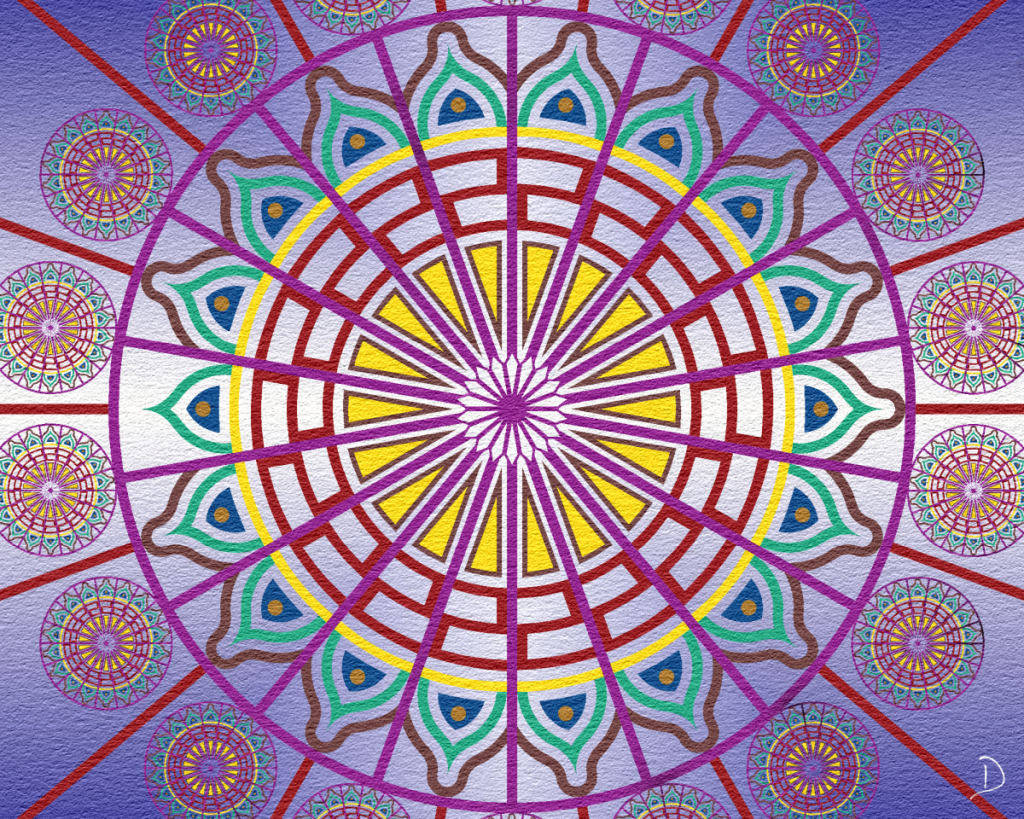
Mandala 081025 – Created by Don Cheke
In one of my earlier blog posts I talked about Islamic, and other types of geometric art. With that on my mind, I decided to travel that road a bit further and produced Mandala 081025. I started with the red stylized backward S – the mid ring of red objects. I designed it first on a sticky-note, thinking I would work it into an 18-degree segment of my design. I don’t know if it signifies anything specific, but being the first component, I thought it might have come from some unconscious part of my mind. I then started to add some details that I thought were interesting, like the blue, teal and brown arches, which felt Islamic to me. The colors too, were specified when I Google searched for Islamic color schemes. I continued to add other elements and what you see as the large main design is what came to be. The scaled copies that fit into the outer segments were an afterthought, which I think worked well. The gradient background, along with the canvas texture, was the result of much experimentation. I didn’t start this piece with the intent of creating a mandala, but it wasn’t long before I realized that that was happening.
Mandalas often reflect inner states of being, or spiritual journeys. Does this mandala speak to you in some way? What would a mandala you create look like, and what would it say about you?
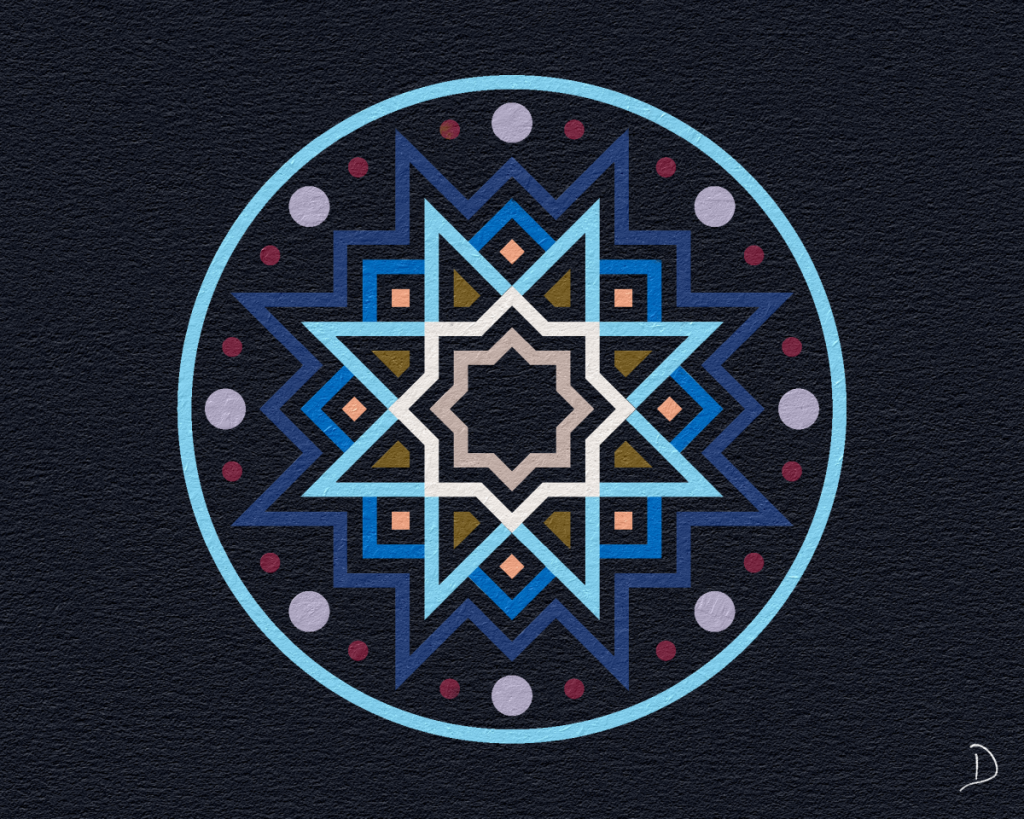
Abstract 081125 – Created by Don Cheke
Abstract 081125 was further exploration into geometric art. I initially created this as 3D art but quickly realized that it would show best as 2D. I started with the central eight-pointed star, which is closely associated with Islamic art and architecture. I chose a subdued color palette, and when I had completed the design, I uploaded it to CoPilot and asked what background color would work best. It suggested black, dark charcoal, or a deep dark blue. I could have worked that out myself, but I was curious. I chose the canvas texture based on experimentation. The one I chose added a soft element to the piece. This piece feels more aboriginal to me, much like a medicine wheel. Somehow it makes me feel a sense of peace.
We’ll finish with one more recent piece.
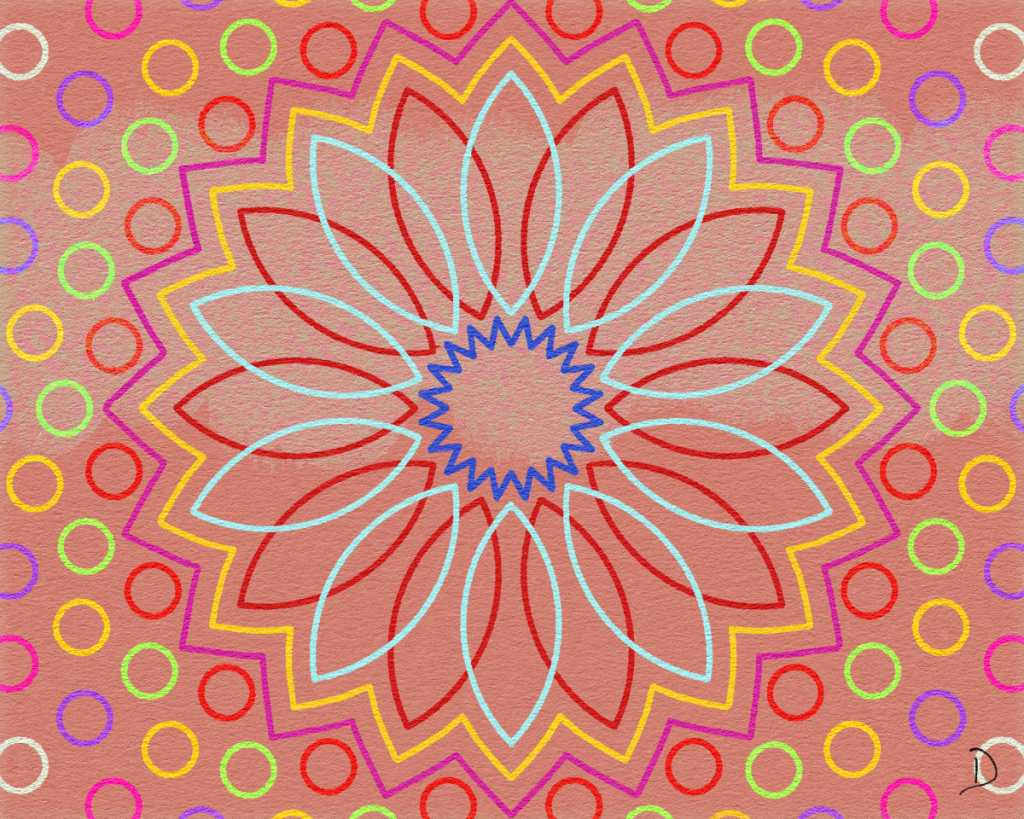
Flower – Created by Don Cheke
For this piece, I first created the pattern in TurboCAD with the intention of creating “paths” that can be brought into my digital painting program and used as guides to apply paint. The export from TurboCAD was not great, so I exported it out to my Affinity Designer program which allowed for a better translation when opened in my paint program. Before importing the paths, I had created a new abstract background. It seems simple, but it took a good stretch of time to get there — as they say, experimentation, experimentation, and more experimentation. With the background colors settled upon, I created a color scheme that I thought would work. The result, along with the choice of canvas, again, makes the piece feel soft, like a lovely flower painted on velvet or a smooth leather. I think that the flower is an expression of love and it radiates a loving glow that transcends time and space.
I hope that you enjoyed the blog post and found lots to think about as you pondered the harvest and the art that followed.
Donald B. Cheke – September 1, 2025
Starting with a bath mat?? Now that is cool, and the result was awesome. Great blog..
Thanks Michael! I am glad that you liked the blog post.
Thank you, Don, for this interesting blog. It really shows how creating art develops from a simple thought or concept. This is particularly the case in abstraction. Contrary to the common opinion, it doesn’t start from nothing to making meaningless art. But I appreciate that abstract art, Aboriginal art, and Islamic art are made for those who are willing to listen to the inner voice rather than just seeing the surface.
The art pieces in this blog are really impressive, and I’m sure they nicely support the concept.
Thanks Suhail, for taking time to read the blog post and to comment. I really like the thoughts you expressed here!
I really appreciate it when a thought pops into my mind and it becomes my muse. I had this happen again today and I started to make notes for another blog post. It is such a creative high when that happens.