

It has been 15 months since I lasted interviewed my wife, Denise, with regards to Living with Parkinson’s Disease. Both she and I have seen many changes over the course of those months, and I thought it might be a good time for an update. As before, this blog post, for the most part, will be presented as an interview with my personal thoughts interspersed as I share our experience dealing with the illness and the feelings and emotions it stirs within.
Parkinson’s Revisited is quite a lengthy read, so grab a coffee or tea and let’s dig in…
Don:
Because one’s current feelings will influence how one responds to questions, I thought I should ask you what head space you are in today. Are you in a good space, a bad space, or a typical space?
Denise:
Well, I have to be honest and say that I’m in what you could call a typical space, in the sense that it varies from a bad space to a good space at any given moment. For example, I woke up this morning and I was in a very bad space. I was frustrated, overwhelmed, discouraged, and a whole bunch of other things. And then I spent a little bit of time talking to my husband, who is my rock, and I felt better. Afterwards I was able to spend a little more time in thought and prayer, for lack of a better word, and then I just got out of my chair and got moving and had other things occur. Right now, a few hours later, I’m in a pretty good space and I’ve had conversations with my daughter, and I’ve been at an Al-Anon business meeting. I’ve also done some sewing, so today, right now, this moment, I’m in a good space. If you had asked me that earlier today, I would have said I was in a bad space. So, does that mean it’s a typical day? I guess so.
Don:
In general terms, do you feel that your Parkinson’s disease (PD) has progressed since the last interview we did?
Denise:
Yes, I believe that it has progressed visibly, perhaps not to such an extent that other people would notice, but I notice. So yes, I feel it has progressed and continues to progress almost weekly.
My thoughts:
I have seen rapid changes. I have seen how this awful disease beats my poor girl down, and I think how awful it must be to have no reprieves from it. Not even in sleep. The changes have been significant enough that I often feel that I have lost her, or don’t recognize her. It takes all my strength to pull back and remain in the day. Although worsening, I have seen Denise adapt to her disease, much more so than 15 months ago.
Don:
Let’s look at some specifics. We’ll break it down into a few major categories. I know that many feelings about these things will overlap, but let’s just try to do the best we can with it. Let’s start with physical aspects.
Physical aspects
Don:
How does PD affect your daily routine?
Denise:
It affects my general daily routine by slowing everything down and by limiting the amount of activity that I can manage on any particular day. It slows things down from where it used to take me an hour to go through my morning routine; getting dressed, brushing my teeth, doing my hair, etc. Now I have to allow a minimum of an hour and a half, sometimes two hours to get ready because everything takes longer. And that’s the same throughout the day. Everything takes longer. Walking to the car takes longer. Getting in and out of the car takes longer. Everything takes longer! I’m slower in my movements physically, both fine motor and gross motor skills. Walking eating, everything takes longer.
My thoughts:
And yet, Denise keeps going, sometimes more than I think she should. I often wish that she would spend more time with self-care, but that is her call. Denise has always been productive and out in the world. She still does that, but it takes a lot more out of her than ever before.
Don:
How is your mobility?
Denise:
I’m grateful that my mobility is still as manageable as it is. I find that my gait is awkward, and my walking is slower. I’m stiffer. My legs and arms, shoulders and body ache all the time. I’m off balance a lot of the time. I frequently find when I’m walking somewhere, if I go to turn a corner or something like that, I lose my balance and I have to stop and rest. But it could be a lot worse. I’m not wheelchair bound, and I could have a lot less mobility than I do. I’m losing it, but slowly.
Don:
What about driving?
Denise:
I still find that I’m a pretty competent driver. I’m sitting so I don’t get dizzy; I don’t lose my balance. My feet and legs are a little bit slower. My reaction time maybe isn’t quite as quick as it is used to be, but the tremors don’t seem to impact my steering or my driving. I just went to Alberta for an uncle’s funeral, and I drove 4 hours there, attended the funeral and drove 4 hours home. I found it to be quite relaxing and I saw that I’m still a pretty competent driver. I dread the day when I’m not, for sure.
My thoughts:
I know that Emma is often with Denise when she is driving and she feels confident with Denise’s driving abilities. I too have followed Denise on occasion when we have met somewhere else and went our separate ways afterwards. I have never seen anything amiss with her driving. She still drives like Mario Andretti! 😊
Don:
I have noticed that you avoid using the walker/wheelchair that we purchased for you. Why do you think that is?
Denise:
I know exactly why that is, it is because I want to maintain my independence as long as I possibly can. I don’t want to be dependent on someone else to push me around. I’m stubborn and I’m fiercely independent. I suspect there’s going to come a day when I’m going to need it, but I don’t want that day to be yet.
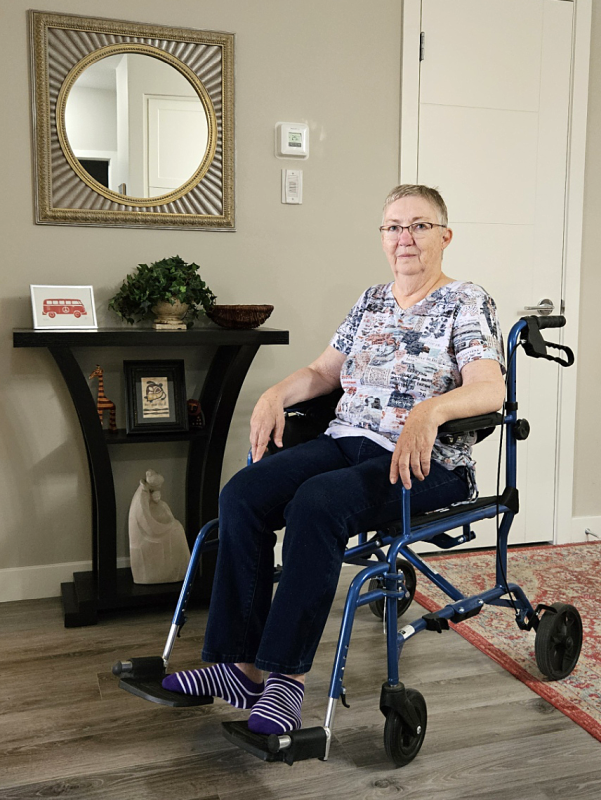
Denise Cheke in Transfer Chair – Photo by Don Cheke
My thoughts:
Did she say she was stubborn!? Let’s just say she sets the high bar for stubbornness, but it’s a sweet and kind stubbornness. Kind of like the heat in the oven is a “dry” heat, as opposed to the wet humid heat we all hate. 😊
Don:
Have you had to give up anything over the last 15 months that you haven’t already given up due to PD?
Denise:
I haven’t had to give up anything more, something completely in the sense of giving it up, like I can’t do it anymore, but I’ve had to give thought to things that I’m doing. I’m restricted in what I can do. For example, taking my granddaughters to the playground. I used to thrive on taking my granddaughters to the playground and playing sea monster and chasing them all over the playground and running up and down the apparatus, and going on the monkey bars, all that kind of stuff that I’m incapable of doing anymore. When I take them to the playground, the best I can do is sit on the bench and watch them. So, I’ve had to restrict some of the things that I do. But I’ve also tried to continue to do things that are difficult, even though they’re difficult. … I guess I had to give up eating soup, because that became an exercise in futility. Other than that, I haven’t really had to give things up, I don’t think. And yet, when I think about it, I guess I try not to focus on this stuff. Thinking more about it, I’ve had to basically give up reading paper books due to the weight and trying to hold the books open. I had to switch to eBooks. That’s one thing for sure. I’ve had to give up a lot of aspects of quilting. I’ve had to give up writing in my journal. I’ve had to give up being the secretary for a group that I belong to. So, I guess there’s things I’ve had to give up. Yeah.
My thoughts:
Denise finally allowed me to purchase her a new Amazon Fire tablet. We ordered it with a stand/holder and that allows Denise to have it opened on the side table or her lap and that helps keep it steady. Page turning is a breeze too. Combine that with setting a larger font and she is a happy camper, or reader, as it were.
Don:
Have you found any new tools to help you live and manage your PD?
Denise:
Yeah, I got the coolest new cutlery. I don’t know how much it really helps, but it seems to. It’s designed for people with Parkinson’s, and it’s bent and twisted so that you don’t have to twist your wrist to get the food into your mouth. It definitely makes things easier. I guess it doesn’t solve the problems, but it helps. Other tools that I’ve discovered. I don’t know. Can you think of any Don? … I bought a cane to try but I didn’t find that helped me keep my balance at all. I make sure I wear good shoes now I suppose, not fashionable ones. That’s funny!
Emotional Aspects
Don:
Do you ever feel like you can’t take one more day of this disease?
Denise:
I sure do! Almost every morning when I wake up, for about 10 seconds I forget that I have Parkinson’s. Then I reach over to try and turn my lamp on, and I am reminded as I just about knock over everything that’s on my nightstand because the shaking is so bad. And I think “I don’t know if I can face this for another day.” Then I gradually get out of bed and begin the process of trying to get dressed. So yes, I definitely have days when I think I can’t do it. I try not to let myself stay there for the whole day. Sometimes, though, I’ve had days, like a whole day of misery, but I try not to stay there for the entire day. But there are definitely times and moments like when making my tea in the morning that I spill sugar all over the counter and I get totally frustrated and I swear, and I shake my fist.
My thoughts:
It’s interesting to note how all these new things caused by the tremors don’t really phase me. I know that the incessant shaking, the spills, the noise from things clanging or tapping regularly, or rubbing, is just part of Denise now. Almost like breathing, and that is not something one pays particular attention to in others. I say this, because I am the kind o f person who would otherwise find these things annoying. It must be love that makes it better. 💖
Don:
Do you suffer any kind of depression having to live and deal with PD? If you do, how do you deal with it?
Denise:
I definitely suffer a certain amount of depression. Particularly if I let myself go to thinking about the things that I wish I could do and can’t, or that are much harder to do. Sometimes I just generally feel sorry for myself, and I don’t know if that’s just because of the PD. I mean, I know that depression is physically part of having PD because my brain cells are dying, the brain cells and the neurons that produce dopamine, which is the good stuff, part of the feel-good brain chemistry. And so, I don’t have as much dopamine in my system, so I feel depressed. So that’s part of what Parkinson’s does to you. So, it’s somewhat situational, but somewhat biological too.
This second part of your question was what do I do to deal with it? I use humor, which my husband doesn’t really appreciate because, well, I don’t know why he doesn’t, but he doesn’t find it as funny as I do, I guess. I’ve always tried to use humor and make fun of myself when things are a struggle. I also talk to my certain special friends a little bit, but I try not to have all the focus on me. I also pray. I read and I use my Al-Anon tools. … And then I pray a little more. … Then I pray a little more. For a large part, I just try and live one day at a time.
My thoughts:
I often look at the effects of Parkinson’s disease as something akin to how well an engine runs. The engine oil is in essence the dopamine and the spark plugs are the smooth firing neurons. Those suffering Parkinson’s do not produce enough dopamine, the cells that produce it are dying off. Dopamine makes the body feel good because it helps make the body system run smoothly. Think of the engine getting less oil than it needs, and the spark plugs firing less effectively. In some ways, having Parkinson’s is like throwing sand and gravel in the oil pan and hoping that the engine is going to perform as it should. Well, it doesn’t. It scratches, it squelches, and it misfires. It keeps things from running smoothly, just like you see in a person suffering Parkinson’s disease. They can’t walk well, their gait is off, their face is off, looking stone-like. All of those various things, because there isn’t enough oil. With the added disadvantage that they can’t clean out the sand and gravel and can’t replace the sparkplugs.
With regards to the humor, I don’t find much humor in Parkinson’s disease. I don’t always appreciate that the humor is at Denise’s expense and that saddens me. Parkinson’s or not, Denise is amazing, and I want her to see herself in that light at all times. That said, I can see the benefit of looking at the big things with a sense of humor. I do that myself, and those are the kinds of things we appreciate in famous comedians, being able to laugh at themselves/ourselves. Gosh, I just created a whole cartoon series that did that very thing. Lighten up, Don!
Spiritual Aspects
Don:
How has your spiritual outlook changed over the last 15 months? Has it become stronger, weaker, or has it been a mixed bag?
Denise:
It has become a mixed bag in a sense that, like most everything, it’s not all one way or the other, it’s a lot of ways. My spiritual life has become much stronger in the sense that I need comfort and reassurance from my higher power, from God, regularly. He is on this journey with me, and I know that with Him I’ll get through the rough times, and I’ll be OK no matter what comes. To rephrase it, I believe there is a higher-power, and I am in His care.
It is weaker in the sense that there are times when I just want to shake my fist and say what the hell, I can’t do this anymore! I blah, blah, blah Him, whatever happens to be happening at the time. Why is this so frustrating!? Why is this so relentless!? One of the things that’s been troubling me most of the past winter, and now into the spring is my perpetual cough which has impacted my voice and impacted my breathing. I don’t know if it’s connected to the Parkinson’s disease or if it’s connected to my heart condition or if it’s connected to the medications I take. It just makes me think, really God, is it not enough that I have Parkinson’s, and now I have to have this too!? So, overall, in general terms, I would say my faith is much stronger than it was when I was initially diagnosed and definitely in last 15 months, but I certainly have moments of doubt and frustration, fear and anger. All that stuff!
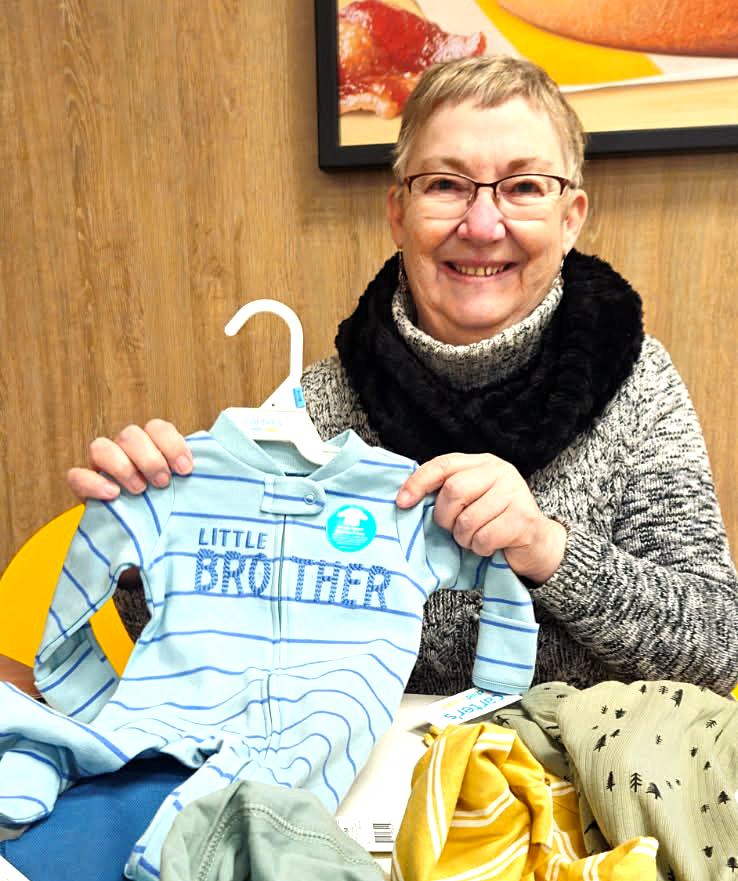
Denise with Onesie – Photo by Emma A.
Healthcare Aspects
Don:
What symptoms do you feel are worsening, and are you discovering new or additional symptoms?
Denise:
What symptoms are worsening? Well, I just mentioned the whole coughing, breathing, shortness of breath. My blood pressure has been giving me great grief. It’s running quite low, particularly the bottom number which I think is the diastolic, but that doesn’t matter. It’s the one where the blood is being pumped out of the heart into the system. When its low it causes me periods of dizziness and light-headedness and headaches. Now if I get up too quickly, I feel quite dizzy. That’s really become apparent in the last few months. My walking and posture have become worse. Sometimes I think I’m getting used to it, but sometimes I catch glimpses of myself in a reflection when I feel like I’m walking like a dinosaur, like I’m shuffling and I’m hunched over, and I don’t like what I see. Other symptoms? I don’t know, there’s so many, but I generally try not to focus on them because I find that if I focus on them, it makes them worse. Even still, sometimes I get scared about what the future holds?
My thoughts:
I get so mad at Denise sometimes when she has these other issues and cancels doctor appointments when something else comes up and others need her. I feel like she puts everyone else before her own well-being. She does a great job telling others “To put on their air mask first” as they say in the event of an airplane crash, but she rarely takes her own advice.
Today, as I write this, (June 24) she has an appointment with her GP to try and get some answers or some med changes to get her blood pressure back to normal and hopefully to address the cough, which could be due to one of her meds, but could be just as easily part of Parkinson’s. There’s a fifty-fifty chance she will cancel it for some “good” reason.
Don:
Has your medicine regime changed over the last 15 months? How do you feel about that?
Denise:
Yeah, last time I saw the neurologist, which would have been probably 6 or 8 months ago, he increased the leva dopa amount that I was taking from 1 tablet four times a day to 1-1/2 tablets, four times a day. He also added an additional medication for my REM sleep disorder, which is where I wake myself up with fits and starts and body movements and uncontrollable shakes, and so on. He put me on an antipsychotic medication called clonazepam to reduce the restlessness. He prescribed 1 tablet at night, but I found that it was making me really groggy in the mornings, so I only take a half tablet. I haven’t told him that yet, because I haven’t seen him again since then.
Don:
Is the healthcare system providing you with enough support to manage your disease and the various emotions that come along with it?
Denise:
The short answer is no. Part of that is my own doing, I suppose. I could make more regular appointments with my family doctor, but I generally don’t. I’m usually doubtful that she’s going to be much help. She’s near retirement, working only two days a week and she’s not particularly knowledgeable about Parkinson’s. But she does know my other conditions. She’s been my doctor for a long time, so perhaps it’s time for me to start making more regular appointments with her. I don’t really like to make appointments with her because it takes forever to get in to see her and I don’t want to be a burden on the resources of the system. In terms of the neurologist? His pattern seems to be to see me once a year. The only reason I got into see him sooner was because I phoned his office and asked for an early appointment. But he’s, well, he’s an expert on Parkinson’s. He doesn’t seem to spend a whole lot of time and give me an opportunity to ask a lot of questions, so not really there for me. I think he’s a great doctor, but I don’t feel particularly supported in all areas. Truthfully, I just kind of feel like I’m swimming through it on my own.
My thoughts,
Like most people, both Denise and I want to see a cure, and when there is none on the horizon and the doctors just seem to be paying lip service to patients, we feel like the system is not doing enough. On the other hand, if one has heart issues, or is having a baby (as our daughter just experienced) they are right on the ball, and you couldn’t ask for better care.
Don:
I know that you wanted to touch on the visible and invisible impact of PD on you. Can list the most obvious ones you experience that you want others to know about?
Denise:
Yeah, well, the most visible ones that everybody notices are the tremors. Sometimes, people say, oh, you’re not trembling right now, is your PD getting better? I think, no, it just has wild moments, or not quite so wild moments, depending on whatever it depends on. But the tremors are just the tip of the iceberg in terms of how this disease is impacting me. It’s impacting me in so many ways that other people don’t see – the stiffness and the slowness, the aching. The constipation and sleeping problems. They don’t see the daytime sleepiness, the nighttime restlessness. They don’t see the mental things, the cognitive things. I don’t know if it’s just part of normal aging or if it’s part of the PD, but the memory things and the confusion! I can’t concentrate when I’m reading, and I don’t see as well as I used to. There’s just so many things that feel like they’re all part of Parkinson’s. I’ve read in my Parkinson’s disease books that this is all so typical and so normal, but people don’t see it unless they’ve done lots of reading about Parkinson’s, they just assume that it just gives you tremors. So, yeah, there’s that, the frustration that most people are not knowledgeable about Parkinson’s, and they don’t realize all that stuff that’s going on behind the scenes. And then there’s my daughter, who does too much research. Recognizing Parkinson’s in everything that’s going on!
My Thoughts:
I know that Denise carries a lot of baggage having grown up with an alcoholic, drug addict, mother, who also was a hypochondriac in a big way. Of course, Denise has never wanted to be viewed in the same light, so I think that she feels if that others know her conditions are real, they won’t look at her in the same light as her mother. I often reassure Denise that those that love her, never see her in that way. We know that what she carries health-wise is not in her imagination. She has a heavy load and it’s too bad she has to have that extra baggage to go along with it. She can usually manage it, but as we all know, when we are struggling, the old tapes in our head can sure kick us when we are down, making a bad situation even worse.
I think too, that because the load Denise carries is heavy, she would like more people to offer her some sympathy. Who doesn’t want that? Having said that, I don’t think that she would like that at all, as it would make her think that people see her as weak. Perhaps that is my own baggage speaking. The best thing I would suggest is to just treat her the same, with the love she always deserves. Or offer a listening ear when she falters in her strength.
Don:
Are you aware of any medical advances in dealing with PD that give you hope?
Denise:
Well, I don’t know of any newer current things. I’m certainly still interested in the whole notion of deep brain stimulation and what that might do. Particularly the aspect of controlling tremors. I know there’s lots of other medications that different people use, and I trust that the neurologist will follow up on me through the years and change things if there’s something he feels needs to be changed. I don’t do a lot of online research in terms of what there might be. I guess I’m kind of too busy just coping. I trust the medical system to tell me if there’s something different I could be trying. For now, I know there’s no cures available.
Relational Aspects
Don:
Where do you find support and understanding when the disease is overwhelming you?
Denise:
I find a lot of support in my husband and my daughter in particular, and in two or three close friends. But again, I try not to talk to them about it too much because I don’t want to be a burden. And I don’t want to be a hypochondriac, and I don’t want to be one of those people that’s always thinking poor me and wanting others to listen to my woes. I don’t like to complain. That’s a whole different trunk of baggage. I find my support in my God. I find joy in my grandchildren, and now there’s a new one since you last interviewed me. That brings me great joy!
My thoughts:
Yes, Luke Paul Arsenault arrived May 26, 2025, a beautiful boy that we, of course, all love.
Don:
Has your relationship with others changed significantly, specifically with family and friends over the last 15 months?
Denise:
I don’t I think I see any changes in the way they respond to me. They just accept me as I am. I know that my granddaughters are very aware of my Parkinson’s, and they often mention it or will ask questions about it. I know that I retreat and withdraw from relationships when I’m struggling because I just don’t even have it in me to connect. That’s not good for me, but it’s just the way it is for now.
Don:
Do you feel that people avoid you or treat you differently knowing, or seeing, that you have PD?
Denise:
Which brings me to the point of getting myself a T-shirt that says, “not drunk, just Parkinson’s.” LOL! To answer the question, no, I don’t think so, because number one, at this stage of the game I don’t think it’s as visible as it could be. And two, people on the outside world, unless they’re really paying attention or unless they’ve had experience with someone with Parkinson’s and would recognize the symptoms, they just don’t notice. Sometimes I feel that I might be judged if we’re out for dinner and I’m shaking and spilling food everywhere or if my husband is feeding me which it has come to a few times. That embarrasses me and makes me feel awkward, but I don’t know if anybody else even really notices or if that’s just all in my head. I do know that I wobble a lot when I’m out in public and I hope that people understand or don’t even notice. But certainly, I mean, I’m not like Michael J Fox. You know, I don’t have the wild body twitches and stuff that he experiences. I think that would change my relationship with others in public or how others in public see me. But I’m not there yet and maybe I’ll never be there because it affects every single person differently. So, so far, I don’t think people necessarily know that I have Parkinson’s.
My thoughts:
Note the humor in first sentence! That’s her Irish humor that I love so much! 😊
Don:
What do you do to maintain a healthy outlook on life? Are there specific things you do that help you remain part of the living, and to enjoy life?
Denise:
Gosh, haven’t I already answered that? What do I do? I go through my routines in the morning. I read my readings. I make my tea; I sit and enjoy some quiet time. I try to set goals or tasks for each day. I still make a list of what my agenda holds. I still make my day plan as I used to do when I was a teacher. I still love to do that because it gives me a sense of purpose and direction. I try to focus on the positive. I try to maintain my sense of humor. I just try to live as normally as I’m able. I know that I don’t do a really good job in terms of self-care; allowing myself to rest when I need to rest. I’m getting better at it, but I sometimes push myself to the limit. Which reminds me, one thing I’ve had to give up is being the caregiver for my mother-in-law. Although I don’t miss many aspects of it, I do miss it to some extent, because it used to give me a sense of purpose and helped me to feel that I was still capable of being helpful to others. And I miss hanging out with her. Again, that’s a question from way back. What else do I do to try and maintain positive positivity? I use the Al-Anon program, especially steps 1, 2 and 3, for those of you who know what those are. Maybe Don will put them in the blog post so that his readers will know. And I try to spend time with the people that I love. I try to laugh. Didn’t I say all of this already, I’m starting to sound like a broken record!?
My Thoughts:
Yes, for years, Denise was the one who did most things for my mom, by choice, and because my mom preferred for it to be just the girls when out and about and for medical appointments over the years. It took twelve years of me constantly offering to take over the caregiving, and Denise only relented not long before she got the actual Parkinson’s diagnosis and was in a health crisis due to her diminished state. Yes, I am telling you this, so you don’t think I was some kind of ass, for having her do all the work for my mother. Since I took over the role, Mom has adjusted and sees that I am as capable as Denise was, and that I can even take her to buy a coat, or panties, should the need arise. 😊
Here are the first three steps:
- We admitted we were powerless over alcohol – that our lives had become unmanageable. (Switch alcohol for Parkinson’s)
- Came to believe that a Power greater than ourselves could restore us to sanity.
- Made a decision to turn our will and our lives over to the care of God as we understood Him.
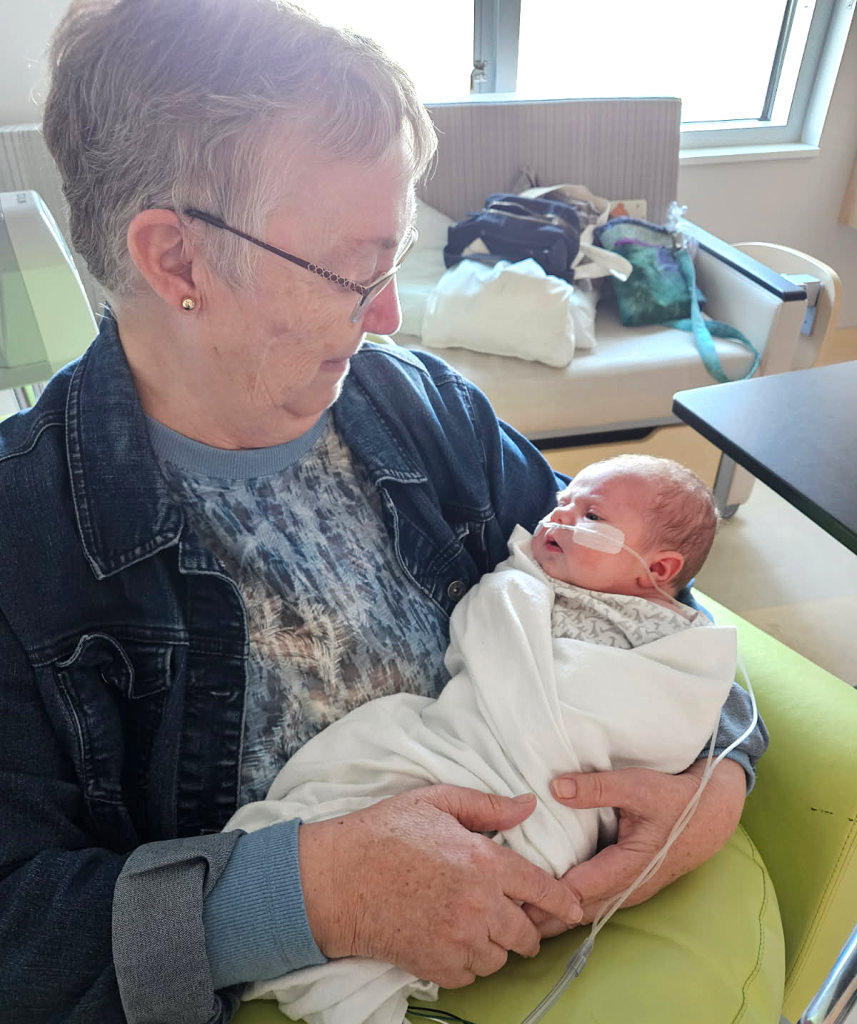
Denise with new Grandson, Luke – Photo by Emma A.
Don:
I have noticed that just recently you have managed to start working on a new quilt. Can you tell me how that came to be, when you had previously given up quilting because of PD? What changed? How does it feel?
Denise:
I thought that I would never be able to quilt again because I was working on a quilt that was quite complex and I couldn’t do it, and I gave up. I started selling off a lot of my quilting fabrics and patterns. That was a very difficult experience, and after a lot of tears I thought, this doesn’t have to be all or nothing. I can’t do what I used to do, but I can still do something when I want to. Right now, I’m working on a quilt for my granddaughter that’s just straight lines; easy blocks, no matching seams, no points, no curves, nothing complex. I am enjoying it, although I find I can only do a short bit at a time because the more I try to focus on the sewing, the more pronounced my tremors become. Things start getting out of control. So, it’s a very different process than it used to be. But, by and large, I enjoy it while I can. And I’m grateful to have come to the decision that it doesn’t have to be all or nothing. I’m excited to be sewing again! And I’m trying to be less of a perfectionist and just accept it as it comes. I can do what I can do with that and that’s it!
My thoughts:
I was happy to be of assistance once again when it came to overcoming limits. Denise was telling me about how her sewing machine would go berserk when her foot would jerk and push the speed pedal to the mat. (Hey, that’s just how she drives – remember the Mario Andretti remark😊). I asked her if there was a governor, or a speed control on her sewing machine. Sure enough, it was right there on the controls, 1, 2, or 3. We tried it out, set to the slowest sped and that did the trick. Now, even if her foot goes wonky, the machine won’t race out of control, it’ll just go to the maximum speed of that setting and then she doesn’t feel like she’s lost control of it at all. I was so glad we found that “fix.”
Don: What are your thoughts about the future for you as far as having PD goes?
Denise:
You know, some days I’m quite optimistic and I’m grateful that the Parkinson’s progression is as slow as it seems to be. In the sense that I didn’t go from the diagnosis to wheelchair bound, or in a bed, unable to get out on my own within a matter of months, which happens to some people. So, I’m grateful that it seems to be progressing at a slower rate than it does for some other people. But I’m also very afraid because every day if I focus on it, I can see small incremental changes. It is changing who I am and what I can do. I fear the loss of my cognitive self; I fear the loss of that even more than the mobility. I fear the mood changes, I fear the memory changes, I fear not being able to concentrate or contribute. So, I’m grateful and cheerful on one hand. I’m trying to just take it one day at a time. On the other hand, I’m a bundle of emotions. I’m a mixed bag. I try not to focus on the fear though, because I don’t want to share that with other people. I try to mask it but it’s there every step I take.
Don:
Do you have any final thoughts on this PD business?
Denise:
Gosh, honey, I don’t know. I think it feels to me like this interview is just a repeat of the last interview but maybe I’ve delved deeper into it. I just try to pretend that I don’t have PD, and yet I’m constantly reminded that I do. I don’t know how other people see me anymore. I don’t know if they see changes in me. I’d like to interview a few of the people that are close to me and ask them some of these questions and hear their thoughts. But it’s my life and it’s what it is and one day at a time is how I will proceed.
End of interview.
To wrap up, I would like to thank Denise for being a willing participant in this blog post interview. She is always so supportive and willing to participate in whatever I throw her way. Because my family and friends read my blog posts, I thought that they would appreciate the update. As Denise said, she puts on a brave face, but the struggles are many.
Part of my blog post mandate has always been to share at the personal level, in part to show the “human” part of me, so others can see that we all have much to carry and deal with, that it isn’t taboo to talk of such things. I hope that my sharing here, allows you to feel and talk openly about your own struggles with family and friends.
A special note to my mother, knowing she will roll her eyes, “Aren’t we lucky to have Denise in our lives! Let us take a moment to pause and give thanks.” 👍😊💖
Donald B. Cheke – July 7, 2024
P.S. Denise did keep her doctor’s appointment. The doctor spent much time with her and adjusted the meds that affect her blood pressure and added a couple short-term ones to see if the cough can be tamed. She also recommended that Denise start back up with her counselor on a more regular basis, since it had been a while since she last went. As much as it requires more effort, I know that Denise always found it beneficial, so maybe she will pay heed to the doctor’s advice.
Thank you both for your beautiful reflections and sharing! The openness of your struggle and the use of so many coping tools is very helpful! Love to you both!
Thanks Doug! I appreciate your love and support. You are a wonderful brother! 💖
Thank you Denise for your honesty and humor. Just what I have experienced all these years. I get the humor. Takes one to know one.
Love you both.
Thanks Dave!